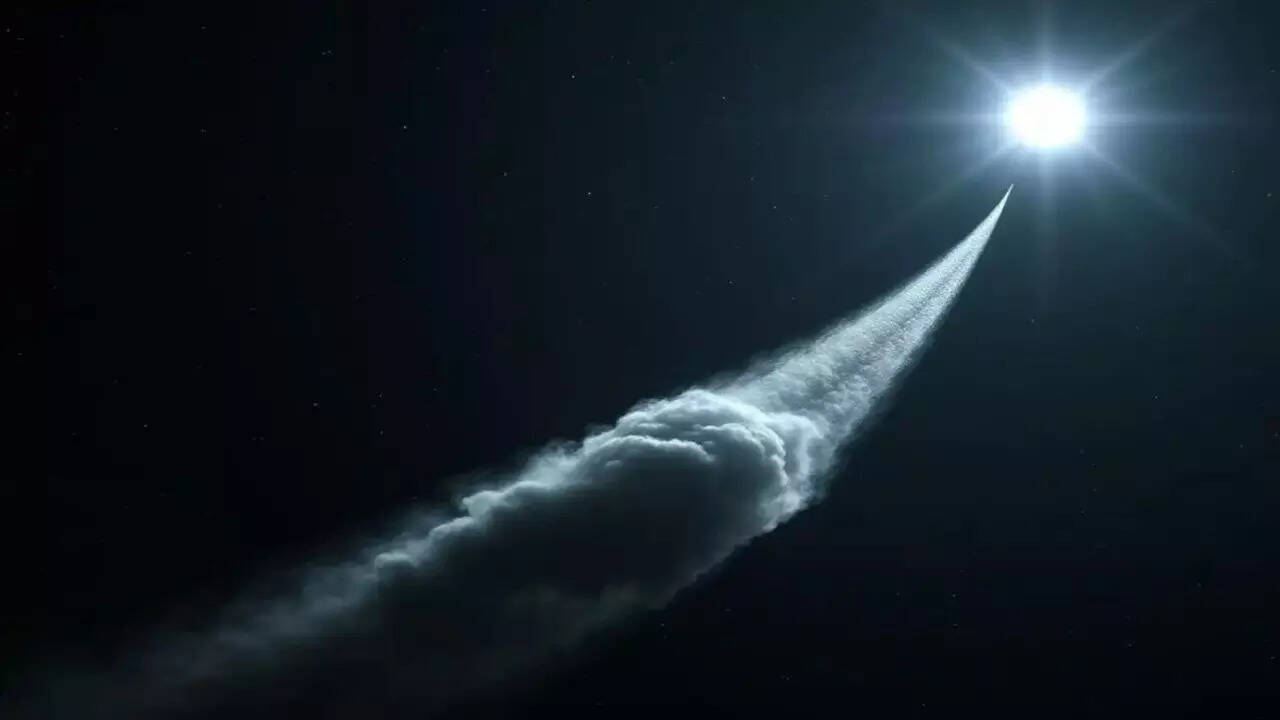
NASA scientists have observed the interstellar comet 3I/ATLAS leaking water in space, marking an unprecedented discovery in cometary science. This phenomenon offers new insights into the composition and behavior of objects originating beyond our solar system.
NASA discovers unique water leakage from interstellar comet 3I/ATLAS, revealing new insights into comet composition beyond our solar system.
NASA has announced a groundbreaking discovery concerning the interstellar comet 3I/ATLAS, which was recently observed leaking water while traveling through space. This finding represents a phenomenon unlike anything previously documented in cometary science and provides important new insights into the nature of celestial objects from beyond our solar system.
Discovered earlier in 2025, the comet 3I/ATLAS has been monitored closely by astronomers for its unusual trajectory and composition. Unlike typical comets that originate within our solar system, 3I/ATLAS is classified as an interstellar comet, meaning it originated from outside our solar neighborhood. Scientists have been particularly interested in studying it to better understand material and processes occurring elsewhere in our galaxy.
Water in space is commonly found in the form of ice on comets and other celestial bodies. However, the active leakage of water from 3I/ATLAS presents a novel observation. NASA researchers reported that the comet exhibits signs of water vapor escaping into space, a process that had not been previously documented for interstellar objects. This leakage is detected through sophisticated instruments aboard space telescopes and observatories that analyze the comet’s spectral signature.
Dr. Elena Rodriguez, a planetary scientist at NASA’s Jet Propulsion Laboratory, explained, “This is a unique opportunity to study water content outside of our solar system. The detection of water leakage from 3I/ATLAS adds a new dimension to our understanding of cometary physics and the distribution of water in the galaxy.”
The presence of water is significant as it plays a crucial role in planetary formation and the potential for habitability. The discovery that an interstellar comet contains and is actively losing water raises new questions about how water is distributed in other star systems and the processes that govern such bodies during their journey through space.
Astronomers utilized data collected from the Hubble Space Telescope and ground-based observatories, which captured the emission lines indicative of water vapor. The comet’s comparatively rapid movement and unique composition made these observations challenging but also richly informative.
The comet’s water leakage differentiates it from most known solar system comets, which typically sublimate water ice near the sun but do not exhibit prolonged leakage in the manner observed. This suggests that 3I/ATLAS has distinct internal structures or volatile materials that respond differently to the space environment.
Researchers hope that continuing to observe 3I/ATLAS as it travels through space will yield further insights into the evolutionary history of cometary bodies and the conditions prevalent in other regions of the galaxy. This discovery underscores the importance of monitoring interstellar objects to enhance our understanding of cosmic material exchange and the genesis of solar systems.
In conclusion, NASA’s detection of water leakage from the interstellar comet 3I/ATLAS marks a significant advancement in space science. This unprecedented finding not only challenges existing paradigms about comet behavior but also opens avenues for further research into the composition and dynamics of objects that traverse interstellar space. Continued study of 3I/ATLAS promises to deepen our knowledge of water distribution beyond the solar system and the complex processes shaping celestial bodies throughout the universe.