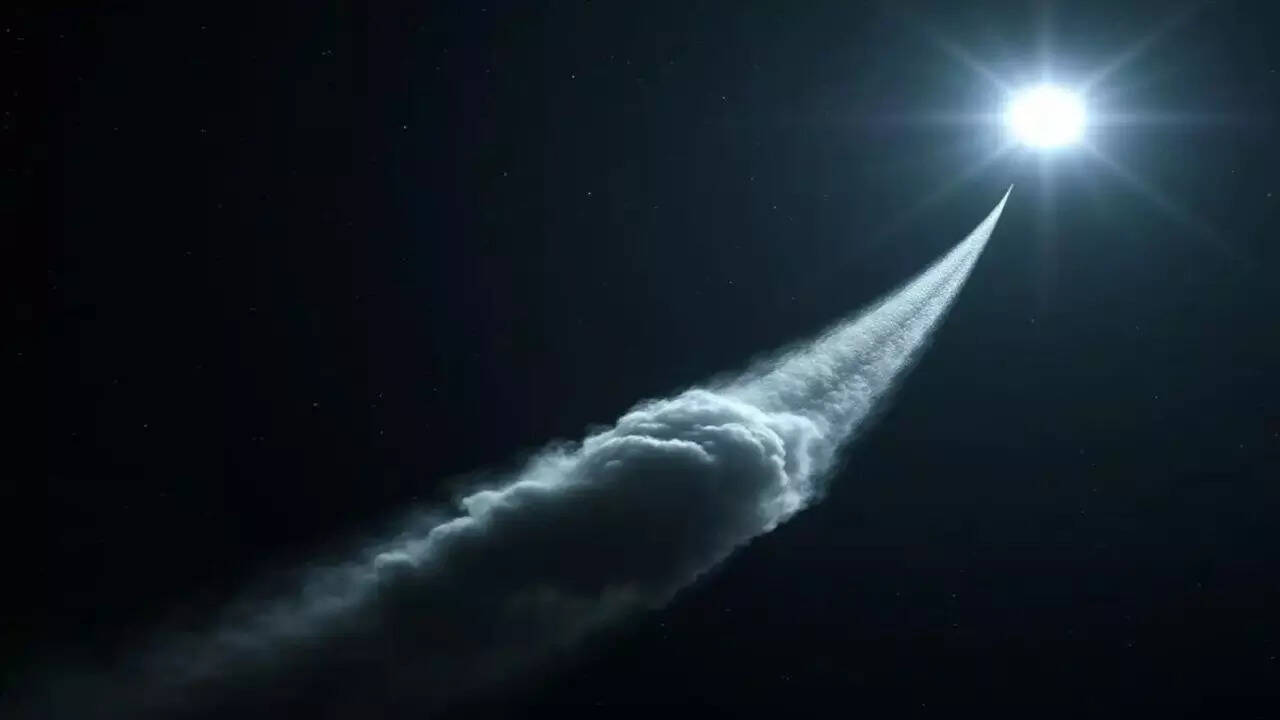
NASA scientists have observed water leaking from the interstellar comet 3I/ATLAS, marking a phenomenon never seen before in space exploration. The discovery provides new insights into the composition and behavior of interstellar objects passing through our solar system.
NASA discovers water leaking from interstellar comet 3I/ATLAS, revealing unique space phenomenon and new insights into interstellar objects.
In a groundbreaking observation, NASA has reported that the interstellar comet 3I/ATLAS is leaking water as it travels through space, an occurrence described as unlike anything previously observed. First detected in early 2023, 3I/ATLAS has captured the attention of astronomers worldwide due to its origin outside our solar system and its unique physical characteristics.
The comet, officially designated 3I/ATLAS, was discovered by the Asteroid Terrestrial-impact Last Alert System (ATLAS) and quickly classified as an interstellar object because of its hyperbolic trajectory, indicating it originated beyond the gravitational influence of the Sun. Unlike typical comets from within our solar system, 3I/ATLAS exhibits unusual behavior, most notably the leakage of water vapor detected by NASA’s orbiting telescopes.
Water in comets is not uncommon; however, the pattern and rate of water release from 3I/ATLAS differ significantly from known examples. Dr. Elena Ramirez, a planetary scientist at NASA’s Jet Propulsion Laboratory, explained, “While water ice sublimation is a common process observed in comets as they approach the Sun, what makes 3I/ATLAS unique is the manner in which water is escaping its surface. The leakage is continuous and seems to be fueled by an internal process, possibly hinting at the comet’s formation environment outside the solar system.”
This discovery provides valuable clues about the building blocks of other planetary systems. Studying water and other volatiles in such objects can enhance understanding of the distribution of life-essential compounds throughout the galaxy. The detection of water leakage on 3I/ATLAS may imply that interstellar comets harbor more complex physical and chemical processes than previously assumed.
The comet’s trajectory has allowed astronomers to conduct detailed spectroscopic studies using instruments aboard space telescopes, such as the Hubble Space Telescope and the James Webb Space Telescope. These observations helped confirm the presence of water vapor in the comet’s coma—the cloud of gas and dust surrounding its nucleus.
NASA officials emphasize that ongoing monitoring of 3I/ATLAS will be crucial to better understand the mechanisms behind its water leakage and to explore if similar processes occur in other interstellar visitors. Dr. Ramirez added, “Each interstellar object we encounter offers a unique opportunity to compare and contrast planetary materials from other star systems with those in our own.”
The study of 3I/ATLAS complements earlier discoveries like ‘Oumuamua and 2I/Borisov, other interstellar objects that have passed through our solar system in recent years. However, 3I/ATLAS stands apart due to its active water emission, an aspect not observed in its predecessors.
As technology advances and more interstellar objects are detected by surveys such as ATLAS and the upcoming Vera C. Rubin Observatory, scientists hope to gather further data to expand knowledge of the origins, compositions, and potential habitability of extrasolar systems. The revelation of water leakage from 3I/ATLAS marks a significant step towards that goal.
In summary, NASA’s observation of water escaping from interstellar comet 3I/ATLAS introduces a novel phenomenon in cometary science and interstellar studies. This finding enriches understanding of the diversity of celestial bodies traveling through space and opens avenues for future research on how water and other vital compounds are distributed across the cosmos.