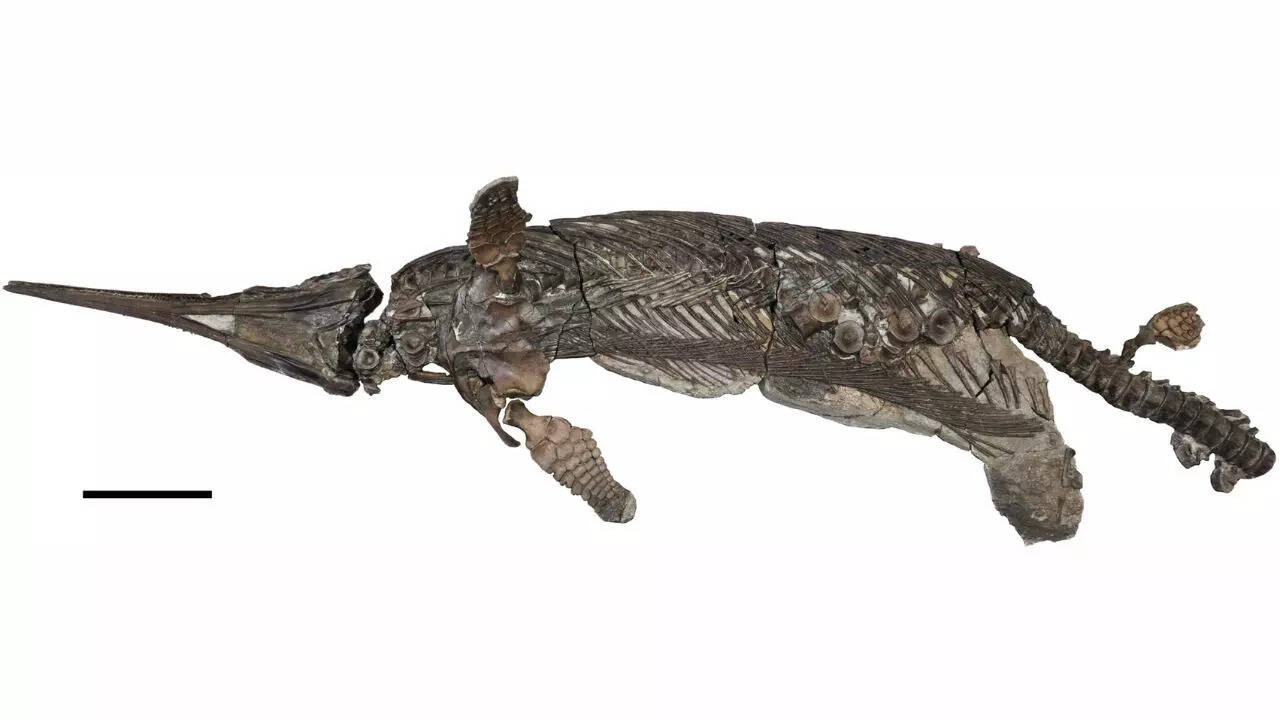
Scientists have uncovered a remarkably well-preserved 190-million-year-old marine reptile featuring a sword-like nose along England’s Jurassic Coast. This extraordinary discovery sheds new light on the diversity of Early Jurassic marine life and provides valuable insights into prehistoric ecosystems.
Discover the 190-million-year-old marine reptile with a sword-like snout unearthed on England’s Jurassic Coast, shedding light on Early Jurassic marine life.
Paleontologists have announced the discovery of a 190-million-year-old marine reptile with a distinctive sword-like snout along England’s famed Jurassic Coast. Uncovered during recent excavations, this remarkable fossil offers a unique glimpse into the marine biodiversity that thrived during the Early Jurassic period.
Unearthing a Prehistoric Sea Dragon
The fossil was excavated from sedimentary rock formations along the Jurassic Coast, a UNESCO World Heritage site known for its rich deposits of prehistoric fossils. Experts identified the specimen as a type of marine reptile, often colloquially referred to as a ‘sea dragon’ due to its resemblance to modern reptiles and mythical creatures. What distinguishes this discovery is the creature’s elongated nasal bone, which resembles a sword, suggesting it may have been used for hunting or display.
Scientific Significance and Preservation
Dr. Emily Carter, a lead paleontologist involved in the excavation, highlighted the significance of the find: “This specimen is exceptionally well-preserved, allowing us to study anatomical features rarely seen in fossils from this period. The sword-like snout is an intriguing adaptation that may have played a critical role in its predatory lifestyle.”
The Early Jurassic epoch, approximately 190 million years ago, was a time of significant evolutionary advancements in marine reptiles. This discovery enriches the scientific understanding of the diversity and specialization of prehistoric marine fauna during this era.
Contextualizing the Discovery
The Jurassic Coast, stretching along the southern coast of England, is renowned for its geological formations that span the Triassic, Jurassic, and Cretaceous periods. This area has continuously provided valuable fossil evidence that informs the fields of paleontology and evolutionary biology.
Marine reptiles, such as ichthyosaurs, plesiosaurs, and the newly discovered sea dragon species, dominated prehistoric oceans. The adaptations observed in this species’ nose may have been used for slashing prey, sensory functions, or mating displays, though further research is needed to confirm these hypotheses.
Future Research and Exploration
The discovery team plans to conduct more in-depth studies, including CT scans and comparative anatomy analyses, to better understand the creature’s physiology and ecological role. Additionally, ongoing excavations aim to uncover more specimens that could shed light on the evolutionary pathways of Early Jurassic marine reptiles.
Conclusion
The uncovering of this 190-million-year-old sea dragon with its distinctive sword-like nose on the Jurassic Coast represents a significant advancement in paleontological research. It highlights the complexity of prehistoric marine ecosystems and emphasizes the importance of the Jurassic Coast as a vital window into Earth’s distant past.