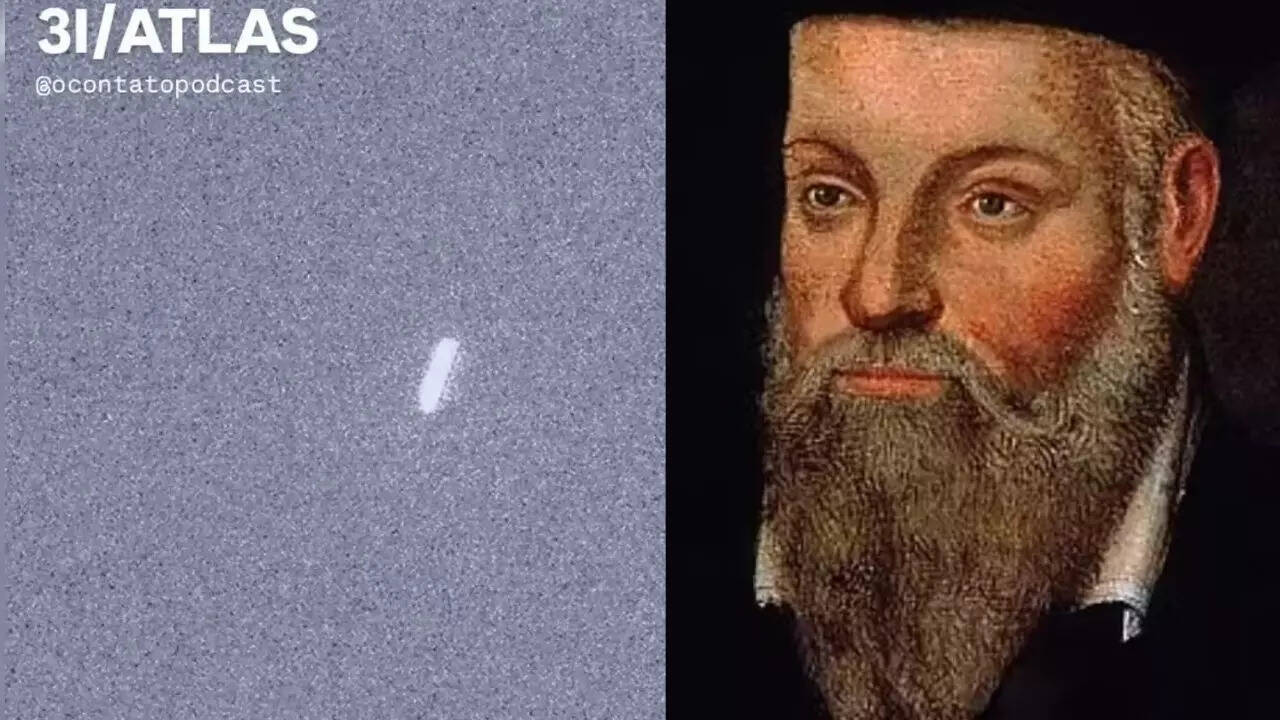
A rare interstellar object named 3I/ATLAS is expected to pass near Earth in 2025, attracting attention from the scientific community and sparking discussions about historical prophecies by Nostradamus. Astronomers are closely monitoring the object’s trajectory to study its origin and composition, while public speculation grows over alleged predictive texts.
Interstellar object 3I/ATLAS will pass near Earth in 2025, attracting scientific study and sparking discussions about Nostradamus prophecies.
A rare interstellar object designated 3I/ATLAS is set to pass close to Earth in 2025, prompting widespread interest both within the scientific community and among enthusiasts of historical prophecy. The object, detected recently by the Asteroid Terrestrial-impact Last Alert System (ATLAS), is notable for its unusual trajectory and origin outside our solar system. Its approach has generated discussions linking it to the centuries-old prophecies of Nostradamus, though scientists emphasize evidence-based observation and caution against unfounded speculation.
Interstellar Visitor 3I/ATLAS: What We Know
3I/ATLAS was first identified by astronomers using the ATLAS telescope network, designed to detect near-Earth objects that could pose potential impact threats. Unlike typical asteroids and comets originating within our solar system, 3I/ATLAS boasts a hyperbolic trajectory indicating it traveled from outside the sun’s gravitational influence. Its path suggests it entered the solar neighborhood from interstellar space, making it only the third confirmed interstellar object observed by humans to date.
According to projections released by space agencies monitoring the object, 3I/ATLAS will make its closest approach to Earth in mid-2025. Although the object poses no known danger of collision, its close passage offers scientists a rare opportunity to study an extraterrestrial visitor in unprecedented detail. Analysis of its composition, speed, and interaction with solar radiation will enhance understanding of materials and phenomena beyond the solar system.
Scientific Community’s Perspective
Dr. Elaine Rodriguez, an astrophysicist with the International Space Observatory, noted, “Interstellar objects like 3I/ATLAS are incredibly valuable to science because they carry information from other parts of our galaxy. Each observation helps us piece together the dynamics of planetary systems beyond our own.”
Experts emphasize that ongoing monitoring and data collection from 3I/ATLAS will continue, with multiple telescopes and space observatories collaborating internationally. The availability of high-resolution imaging and spectrometry will help confirm hypotheses about its origin and physical characteristics.
Nostradamus and Public Speculation
In parallel with scientific attention, there has been renewed public interest in possible connections between 3I/ATLAS and the 16th-century prophecies of Nostradamus, a French astrologer and seer whose quatrains have often been interpreted as foretelling major events.
Some enthusiasts have pointed to cryptic verses referencing celestial phenomena and unusual visitors as potential allusions to the interstellar object. However, historians and scholars caution against literal interpretations. Professor Mark Eldridge, a historian specializing in Renaissance-era texts, explained, “Nostradamus’s writings are notoriously ambiguous and open to wide interpretation. Correlating them directly with modern astronomical events can be misleading and lacks rigorous evidence.”
The juxtaposition of scientific discovery and historical prophecy highlights the intersection between empirical inquiry and cultural fascination with the unknown. While Nostradamus continues to captivate imaginations, the scientific method remains paramount in understanding phenomena like 3I/ATLAS.
Looking Ahead
As 3I/ATLAS approaches Earth, global observatories are preparing for intensive observation campaigns. Space agencies intend to gather and analyze data that may reveal insights about the object’s composition, velocity, and potential origins.
This event underscores the increasing capability of modern astronomy to detect and study interstellar objects, which were once purely speculative. It also underlines the importance of clear communication between scientists and the public to balance excitement with accurate information.
In conclusion, the upcoming passage of 3I/ATLAS offers a unique window into an interstellar visitor entering our cosmic neighborhood. While it ignites both scientific investigation and cultural curiosity, the emphasis remains on empirical research to unlock its mysteries without conflating them with historical prophecies.