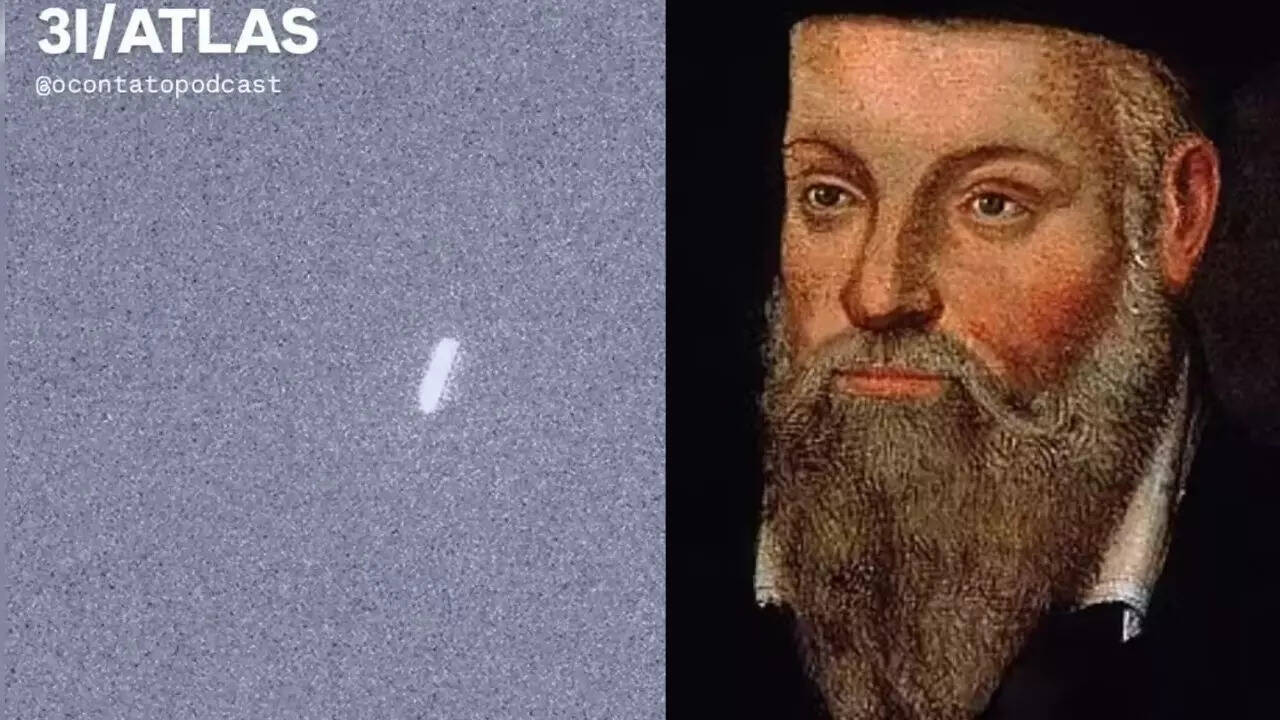
The rare interstellar object 3I/ATLAS is predicted to approach Earth in 2025, drawing significant interest from both the scientific community and enthusiasts of historical prophecies. Speculation has arisen regarding whether Nostradamus may have foretold this cosmic event centuries ago.
Rare interstellar object 3I/ATLAS will pass Earth in 2025, sparking scientific study and Nostradamus prophecy discussions.
A rare interstellar object designated 3I/ATLAS is expected to make a close approach to Earth in 2025, stirring considerable scientific observation and widespread public intrigue. This discovery is prompting not only extensive astronomical studies but also renewed discussions around the historical prophecies of Nostradamus, a 16th-century French astrologer reputed for his cryptic predictions. Identified by the Asteroid Terrestrial-impact Last Alert System (ATLAS), 3I/ATLAS is classified as the third known interstellar object to enter our solar system, following the notable detections of ‘Oumuamua in 2017 and comet 2I/Borisov in 2019. Interstellar objects are celestial bodies originating outside the solar system, providing invaluable insights into the composition and dynamics of extrasolar environments. According to astronomers monitoring 3I/ATLAS, the object is projected to pass within a close orbital distance of Earth in late 2025. Scientists are particularly eager to analyze its trajectory, composition, and physical characteristics to deepen understanding of interstellar material and its interaction with the solar system. “This is a rare opportunity to study material originating from beyond our solar neighborhood,” states Dr. Laura Kim, an astrophysicist at the International Space Observatory. “Each interstellar visitor helps us piece together the broader puzzle of planetary system formation and the diversity of cosmic bodies.” Alongside scientific interest, the approach of 3I/ATLAS has ignited fascination among enthusiasts of prophecy and esoteric histories. Some speculate that Nostradamus, whose quatrains have historically been interpreted to predict significant events, may have alluded to the arrival of such an object. However, experts caution against drawing direct connections without substantial evidence. Dr. Michael Harris, a historian specializing in Renaissance-era prophecies, notes, “Nostradamus’ writings are notoriously vague and open to interpretation. While it is tempting to link recent cosmic events to his predictions, rigorous scrutiny reveals that these are broad metaphors rather than precise forecasts.” The confluence of scientific discovery and cultural interest underscores the enduring impact of celestial phenomena on human imagination. The detection of interstellar objects like 3I/ATLAS not only expands our empirical knowledge but also inspires dialogue across disciplines and communities. As 3I/ATLAS approaches, observatories worldwide are preparing to conduct detailed observations using an array of telescopes and instruments. Data collected will inform models of its origin and composition, potentially revealing clues about interstellar travel and the processes governing distant star systems. The expected flyby in 2025 will be closely followed, with updates disseminated through scientific channels and media outlets eager to inform the public. In summary, the impending passage of 3I/ATLAS represents both a milestone in astronomical research and a stimulus for cultural and historical discourse. While the scientific community anticipates new insights into interstellar matter, the public remains captivated by the historical and prophetic narratives that such rare cosmic visitors inspire.