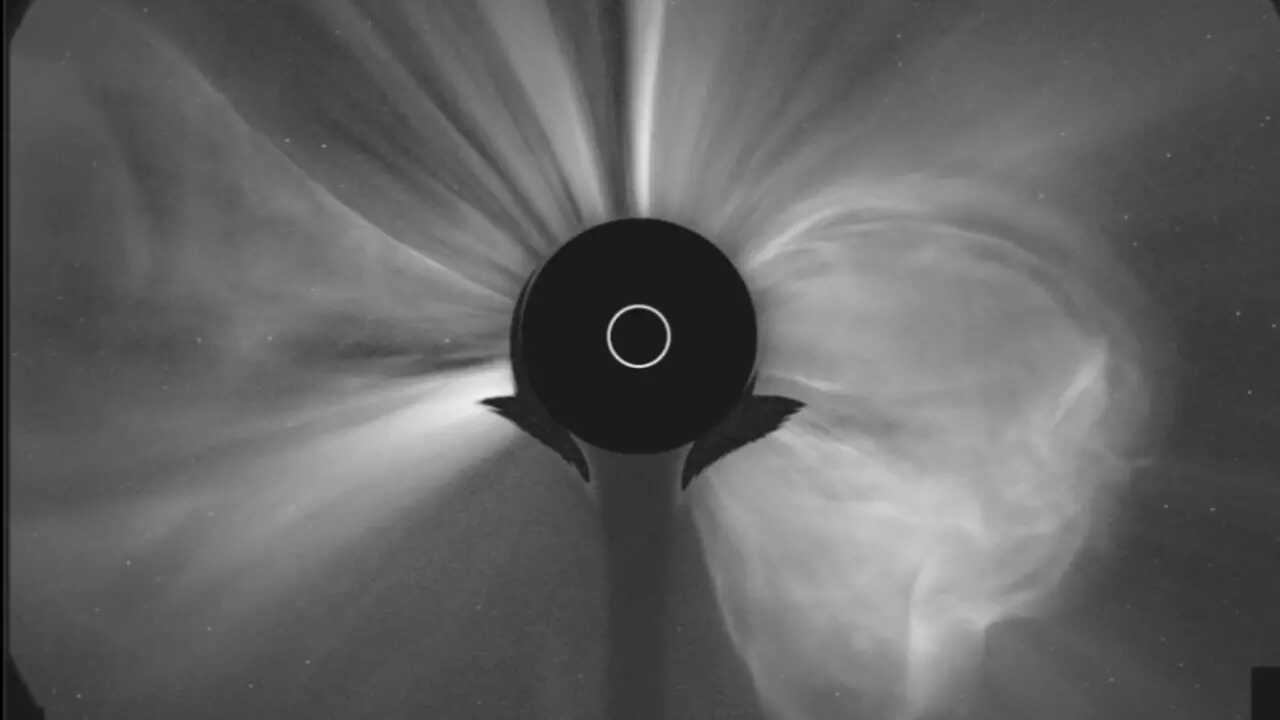
NASA’s spacecraft has recorded the interstellar comet 3I/ATLAS reaching its peak brightness as it approached close proximity to the Sun. This unprecedented observation provides valuable insights into the properties and behavior of interstellar objects traversing our solar system.
NASA spacecraft monitor interstellar comet 3I/ATLAS reaching peak brightness near the Sun, revealing key insights into its composition and behavior.
NASA spacecraft have successfully documented the interstellar comet 3I/ATLAS attaining peak brightness as it neared the Sun, offering astronomers a rare glimpse into the characteristics of objects originating beyond our solar system. Detected first in early 2025, the comet’s journey through the inner solar system has been closely monitored to understand its composition and activity under intense solar radiation.
The interstellar comet 3I/ATLAS, named for being the third identified interstellar object and discovered by the Asteroid Terrestrial-impact Last Alert System (ATLAS), has captured scientific interest due to its unusual trajectory and dynamic behavior. As it approached perihelion, the point of its closest approach to the Sun, the comet brightened significantly. NASA’s spacecraft instruments recorded this peak brightness, which is crucial for analyzing volatile materials and surface properties.
According to NASA scientists, the data obtained during the comet’s close solar pass allows unprecedented analysis of how interstellar materials react to solar heating. Dr. Linda Martinez, an astrophysicist involved with the observation campaign, remarked, “Observing 3I/ATLAS at its brightest near the Sun provides us valuable information about its composition and the processes influencing its activity. These insights help us understand the nature of interstellar visitors and the broader dynamics beyond our solar neighborhood.”
The observations were conducted using a combination of NASA’s solar-observing spacecraft equipped with advanced imaging and spectrometry tools capable of withstanding intense solar glare. These instruments captured high-resolution images and spectroscopic data, revealing details about the comet’s coma and tail formation as solar radiation sublimated its icy constituents.
Understanding interstellar objects like 3I/ATLAS is of significant scientific interest because they offer a direct sample of material from other star systems. Unlike native comets and asteroids, interstellar objects may contain primordial substances that shed light on the conditions and processes occurring in distant regions of our galaxy. The peak brightness event near the Sun thus represents a unique opportunity to study an otherwise ephemeral visitor in detail.
Following its perihelion passage, 3I/ATLAS is expected to continue moving away from the Sun and the inner solar system, fading in brightness as solar heating diminishes. Researchers plan to analyze the extensive data collected to refine models of interstellar comet composition and behavior, which could inform future detection and study of similar objects.
This successful recording of 3I/ATLAS’s peak brightness stands as a testament to NASA’s advancing capabilities in monitoring transient, high-interest celestial bodies. It also marks a milestone in interstellar object research by providing a comprehensive dataset during a critical phase of the comet’s trajectory.
In summary, NASA’s spacecraft observations of the interstellar comet 3I/ATLAS as it reached peak brightness near the Sun offer valuable scientific insights into its material composition and activity patterns. These findings contribute to a deeper understanding of interstellar visitors and their interaction with our solar environment, enhancing our knowledge of the broader cosmos.