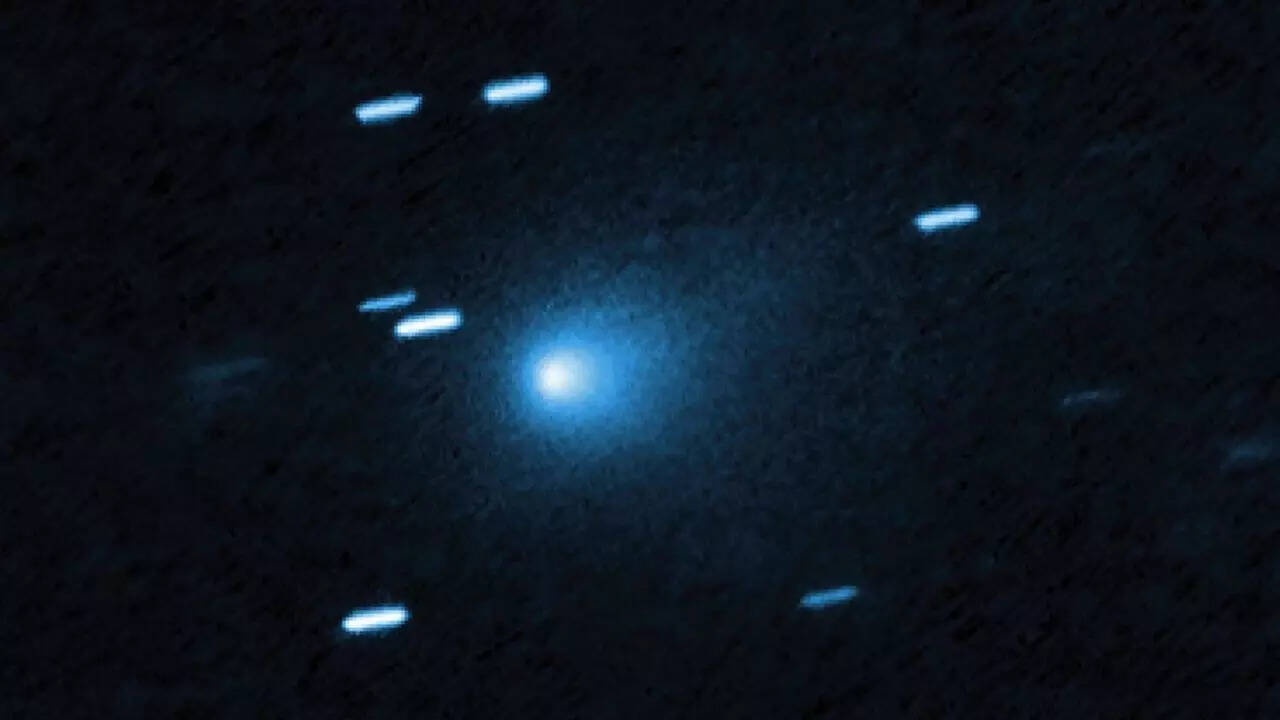
Scientists have identified an unusual pulse signal exhibiting a Fibonacci sequence emitted from the interstellar object 3I/ATLAS at the hydrogen line frequency of 1420 MHz. The pattern raises intriguing questions about its origin and potential as an intentionally crafted message from deep space.
Scientists detect a mysterious Fibonacci-patterned pulse signal from interstellar object 3I/ATLAS at 1420 MHz, raising questions about a possible message from deep space.
Astronomers monitoring the interstellar object 3I/ATLAS have detected a mysterious pulse signal characterized by a distinct Fibonacci number pattern at a frequency of 1420 MHz. This discovery has sparked significant interest in the scientific community regarding the possible origins and implications of such a structured emission.
The signal, recorded as a sequence of pulses measuring 8, 13, 8, 5, 13, and 8 units respectively, aligns with numbers from the Fibonacci sequence—a series recognized by the sum of preceding two numbers generating the next. The repetition and arrangement of these pulses have led researchers to question whether this phenomenon is a naturally occurring astrophysical event or an intentional message from an extraterrestrial intelligence.
Subsequent observations were conducted using several radio telescopes equipped to monitor the 1420 MHz frequency, commonly known as the hydrogen line, which is often targeted in searches for extraterrestrial communications due to its universal cosmic significance. The hydrogen line is an electromagnetic emission resulting from neutral hydrogen atoms and serves as a natural beacon in space.
Dr. Meera Desai, a leading astrophysicist involved in the project, explained, “The detection of a signal carrying a Fibonacci pattern at the hydrogen line frequency is highly unusual. While natural cosmic phenomena can exhibit periodic signals, the specific numerical pattern raises questions about possible deliberate encoding.”
3I/ATLAS, first observed in 2023, is an interstellar object passing through the solar system exhibiting comet-like characteristics. Its origin beyond our solar system has made it a subject of extensive observation and study. The recent findings add a new layer of intrigue to this enigmatic body.
Scientists caution that interpreting the pulse sequence as an intelligent message remains speculative. The natural universe is capable of producing complex signals through various processes, including interactions with cosmic magnetic fields, plasma oscillations, or other astrophysical mechanisms. However, the Fibonacci sequence is a mathematical concept widely regarded as a universal pattern, often cited in discussions about potential extraterrestrial communication protocols.
“We are continuing our analysis with more sophisticated signal processing techniques to rule out terrestrial interference or instrumental artifacts,” said Dr. Desai. “Collaborative international efforts are underway to monitor 3I/ATLAS and confirm the persistence and characteristics of this pulse pattern.”
The discovery has attracted attention from both the scientific community and the public interested in the search for extraterrestrial intelligence (SETI). Historically, the hydrogen line has served as a prime frequency band in SETI initiatives since its first proposed use in the mid-20th century.
Leading SETI researcher Dr. Alan Wexler commented, “While it is too early to draw conclusions, any structured signal from an interstellar object warrants thorough investigation. The Fibonacci pattern is particularly fascinating due to its mathematical uniqueness.”
As scientists continue to collect data and analyze the signal from 3I/ATLAS, the world watches closely for new developments that might enhance our understanding of this unprecedented find. Whether the pulses indicate a natural cosmic process or an enigmatic message from deep space remains to be seen.
In summary, the detection of a Fibonacci-patterned pulse signal at the 1420 MHz hydrogen line frequency from the interstellar object 3I/ATLAS has opened a new chapter in ongoing astrophysical research and the quest to understand signals from beyond our solar system. Further studies are essential to ascertain the nature and origin of this compelling phenomenon.