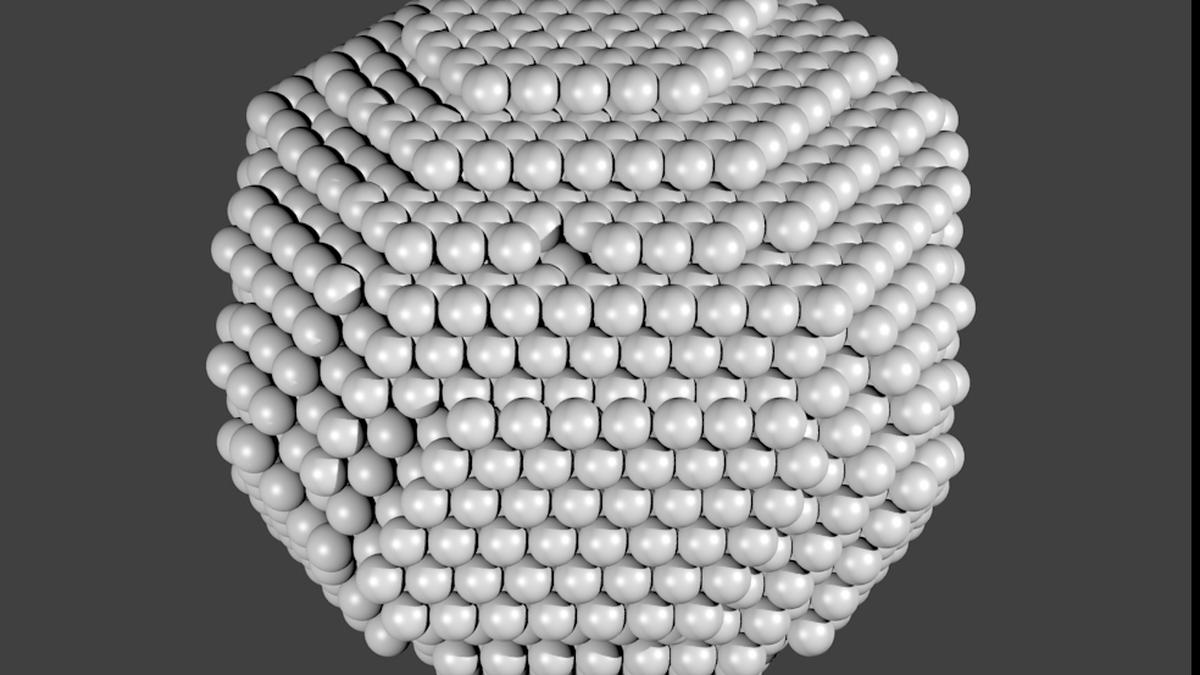
Researchers have pioneered the use of ‘atomic stencils’ to precisely engineer designer nanoparticles, enhancing control over their structure and properties. This breakthrough, reported in a recent study, promises advancements in nanotechnology applications across medicine, electronics, and materials science.
Scientists develop atomic stencil technique to precisely fabricate designer nanoparticles, advancing nanotechnology for medicine, electronics, and materials science.
Scientists have unveiled a novel method employing ‘atomic stencils’ to fabricate designer nanoparticles with unprecedented precision, opening new avenues in nanotechnology. The research, published on October 22, 2025, demonstrates how these atomic-scale templates enable meticulous control over nanoparticle shape and size, enhancing their functional capabilities for various industrial and medical applications.
Atomic Stencils Enable Precision Nanoparticle Engineering
The study, conducted by a team of researchers at an advanced materials laboratory, introduces atomic stencils—nano-sized templates that serve as guides for constructing nanoparticles atom by atom. By harnessing this approach, the scientists can dictate the exact arrangement of atoms, allowing for the tailored synthesis of nanoparticles with desired properties and functionalities.
“Our technique allows us to manipulate matter at a fundamental level, crafting nanoparticles with atomic precision,” said the lead researcher. “This opens up exciting possibilities for designing materials that perform specific tasks with high efficiency.”
Implications for Medicine, Electronics, and Beyond
Nanoparticles have a broad spectrum of applications, including targeted drug delivery, catalysis, and electronic devices. However, controlling their morphology and surface characteristics has remained a significant challenge. The atomic stencil method addresses these challenges by providing a scalable and reliable pathway to fabricate nanoparticles customized for particular uses.
For instance, in medicine, precisely shaped nanoparticles can improve drug delivery systems by enhancing targeting capabilities and minimizing side effects. In electronics, customized nanoparticles can lead to more efficient components with reduced energy consumption.
Technological Advances and Future Prospects
The approach leverages cutting-edge microscopy and lithography techniques to create the atomic stencils on surfaces where atoms can be deposited selectively. This enables the design of nanoparticles with complex geometries that were previously unattainable.
Experts suggest that integrating this method with existing manufacturing processes could accelerate the development of next-generation materials with tailored properties, fostering innovation across multiple sectors.
Conclusion
This pioneering work with atomic stencils marks a significant step forward in nanoparticle fabrication technology. By allowing precise atomic-level control over nanoparticle construction, the research promises to advance the capabilities of nanomaterials in diverse fields including healthcare, electronics, and material sciences.
As the method matures, it could pave the way for customized nanoparticle solutions that meet specific industrial needs, driving progress in nanotechnology and beyond.