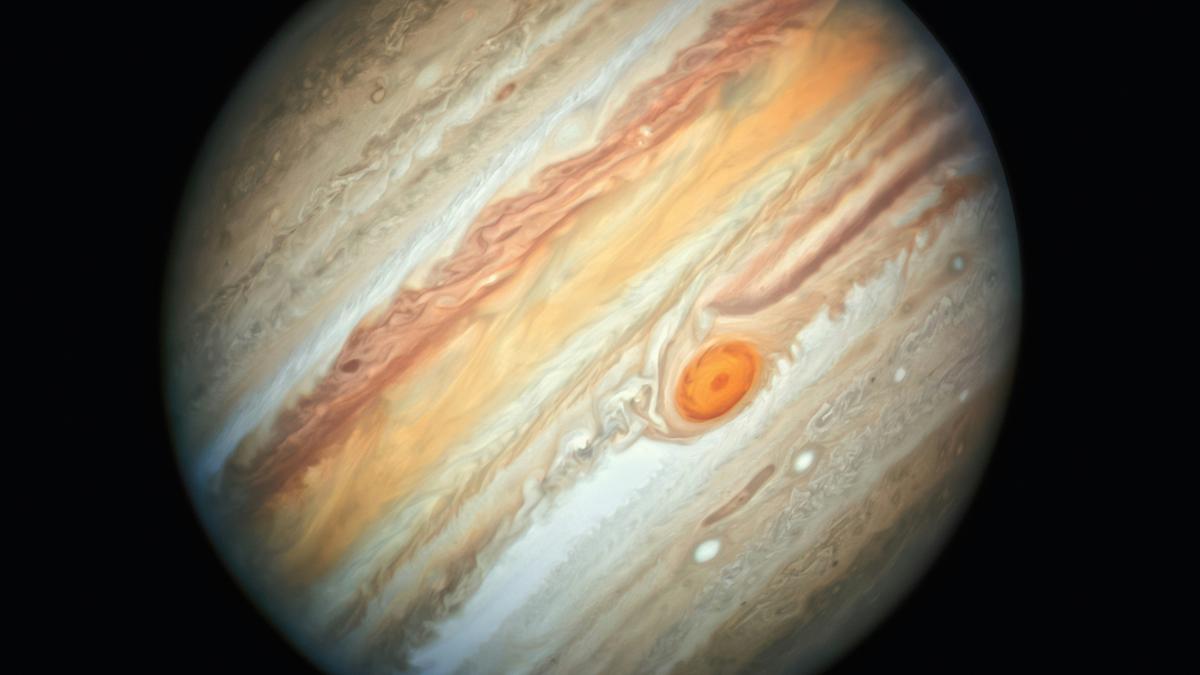
Jupiter, the largest planet in our solar system, boasts an extraordinarily strong gravitational force. Scientists continue to study its gravity to understand its influence on neighboring celestial bodies and potential impact on future space missions.
Discover how strong Jupiter’s gravity is and its impact on our solar system, with insights from recent space missions and scientific research.
Jupiter’s Gravity: Unveiling the Strength of the Solar System’s Giant Planet
Jupiter, known as the largest planet in our solar system, has a gravitational pull that far exceeds that of Earth, making it a subject of fascination for astronomers and space scientists. As of October 2025, ongoing research and missions continue to shed light on just how powerful Jupiter’s gravity truly is and what effects it has within our cosmic neighborhood.
The Strength of Jupiter’s Gravitational Pull
Jupiter’s mass is approximately 318 times that of Earth, which contributes to its incredible gravitational strength. Its surface gravity is roughly 2.5 times stronger than Earth’s, exerting a pull that is capable of attracting and influencing nearby objects with significant force. This immense gravity not only affects Jupiter’s own moons but also plays a role in shaping the orbits of asteroids and comets in the vicinity.
The planet’s gravity well is so intense that it can capture passing space debris and small celestial bodies, making Jupiter a kind of cosmic guardian or vacuum cleaner within the solar system. This phenomenon is important for protecting inner planets, including Earth, from potential asteroid impacts. The powerful gravitational force also creates complex dynamics in the planet’s extensive system of rings and moons.
Exploration and Measurement
Space agencies such as NASA and ESA have launched missions to better understand Jupiter’s gravitational environment. The Juno spacecraft, which has been orbiting Jupiter since 2016, has provided invaluable data on the planet’s internal structure and gravity field. By analyzing gravitational variations, scientists gain insights into the composition and atmospheric dynamics of the gas giant.
Understanding Jupiter’s gravity is crucial for planning future space missions. Spacecraft trajectory design requires careful calculations to leverage gravity assists or to avoid being pulled uncontrollably into Jupiter’s atmosphere. The knowledge gained also aids in predicting the behavior of objects influenced by Jupiter, such as its numerous moons and passing comets.
Jupiter’s Role in Our Solar System
Jupiter’s vast gravitational influence extends beyond immediate proximity. Its presence affects the asteroid belt between Mars and Jupiter, preventing the formation of another planet and instead maintaining a region filled with numerous rocky bodies. Additionally, Jupiter’s gravity occasionally shifts the orbits of comets, redirecting some toward the inner solar system or ejecting them into space.
This giant planet’s gravity has shaped the solar system’s architecture over billions of years, playing a pivotal role in the evolution of planetary orbits and the distribution of celestial material.
Conclusion
Jupiter’s gravity is a dominant force within our solar system, far surpassing Earth’s gravitational strength. Through missions like Juno, scientists have enhanced our understanding of this immense gravitational pull and its wide-ranging effects. From influencing orbital patterns to protecting Earth from potential impacts, Jupiter’s gravity remains a key factor in the dynamic environment of our cosmic neighborhood.