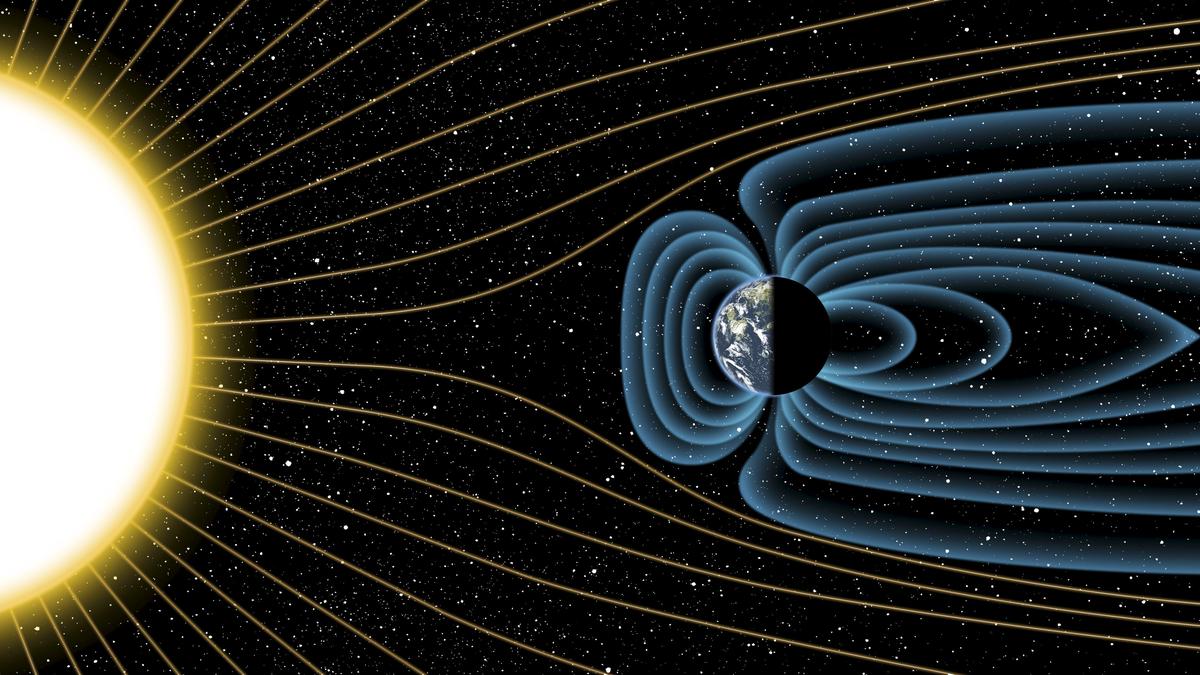
Scientists have long observed that Earth’s magnetic field exhibits localized regions of reduced intensity, known as weak spots. Recent studies attribute these variations to complex interactions in the planet’s core and dynamic processes in the magnetosphere.
Explore the causes behind Earth’s magnetic field weak spots, their impact on satellites, and ongoing research revealing dynamic core processes.
Earth’s magnetic field is essential for protecting the planet from solar radiation and cosmic particles, yet it is characterized by regions known as ‘weak spots’ where the magnetic intensity is significantly lower. Scientists and researchers worldwide have been investigating the reasons behind these magnetic anomalies. The phenomenon was highlighted in recent research published on October 17, 2025, providing deeper insights into the causes and implications of these magnetic field variations.
The Earth’s magnetic field originates primarily from the geodynamo effect occurring within its liquid outer core, composed mainly of iron and nickel. Movements within these conductive materials generate electric currents, which in turn create magnetic fields. However, due to the complex and turbulent nature of this process, the magnetic field is not uniform across the globe.
One well-known weak spot, the South Atlantic Anomaly, is a particularly striking example of reduced magnetic intensity. This anomaly has been extensively studied due to its influence on satellites and space missions. The area exhibits a magnetic field strength noticeably lower than the global average, causing increased radiation exposure for spacecraft passing through it. Scientists suggest that factors such as fluctuations in the flow of molten iron in the outer core and interactions with the solar wind contribute to this phenomenon.
According to geophysicists, the magnetic field’s strength and configuration are influenced by variations in the Earth’s outer core fluid dynamics, including changes in the convection currents and the movement of heat within the core. These internal processes lead to uneven magnetic field generation, resulting in weak spots on the Earth’s surface. Furthermore, the geomagnetic field is constantly evolving, with weak spots shifting and varying over time due to the dynamism beneath the planet’s crust.
The impact of weak spots goes beyond academic interest, affecting satellite operations, telecommunications, and navigation systems. Satellites traversing regions like the South Atlantic Anomaly experience heightened exposure to charged particles, potentially damaging onboard electronics and requiring mitigation strategies by space agencies.
In addition to the core processes, the interaction between the magnetic field and solar activity also plays a role. Solar storms and fluctuations in the solar wind can distort the magnetosphere, temporarily altering the intensity and structure of magnetic fields in certain areas.
Recent advancements in satellite-based measurements and magnetic field modeling have allowed scientists to map these weak spots with higher precision than before. Continuous monitoring helps in predicting changes that might influence technological infrastructure and provides insight into the Earth’s interior dynamics.
In conclusion, the Earth’s magnetic field weak spots are caused by a combination of complex internal processes within the planet’s liquid outer core and external factors such as solar wind interactions. These regions represent areas where the magnetic field intensity is lower, leading to practical implications for satellite operations and space exploration. Ongoing research and improved observational technologies continue to enhance understanding of these magnetic anomalies and their implications for both Earth and human technology.