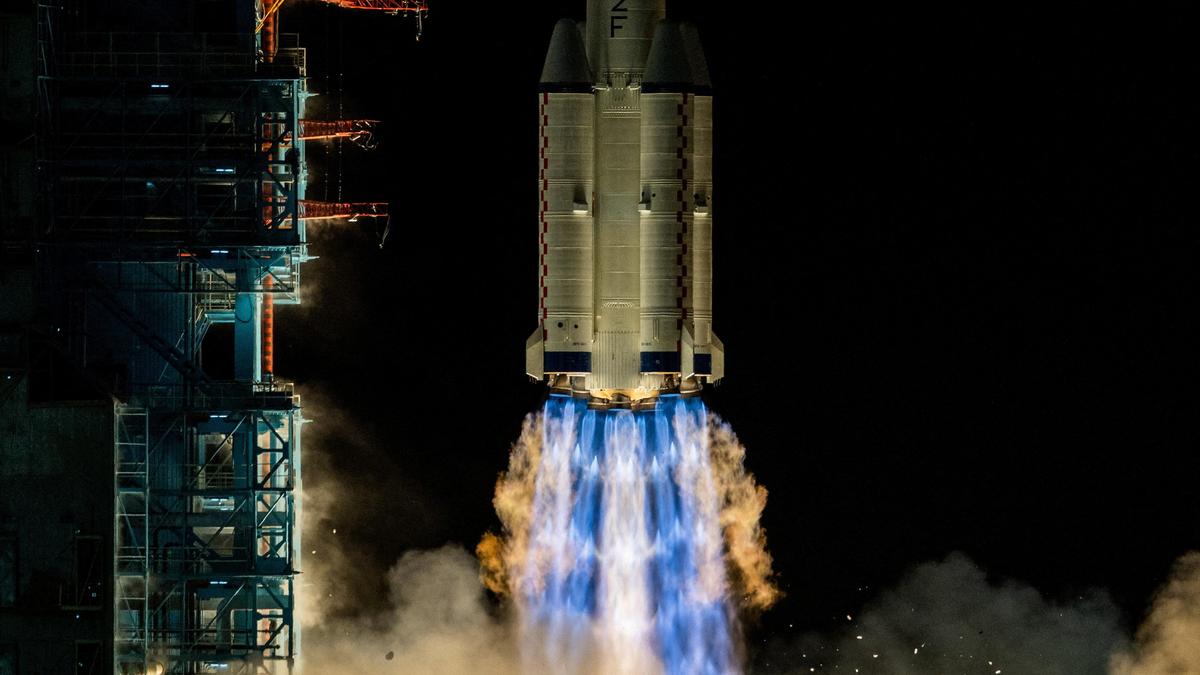
China’s Shenzhou-20 crew returned safely to Earth on November 14, 2025, following a delayed landing caused by orbital debris concerns. The mission, which involved critical operations on the Tiangong space station, highlights increasing challenges posed by space debris.
China’s Shenzhou-20 astronauts safely return to Earth after a delayed landing caused by orbital debris concerns, highlighting increasing space safety challenges.
China’s Shenzhou-20 astronauts have safely returned to Earth after their planned landing was postponed due to the presence of orbital debris, the China Manned Space Agency (CMSA) confirmed on Friday, November 14, 2025. The crew touched down in the Inner Mongolian region, successfully concluding a mission that advanced China’s Tiangong space station construction and scientific research.
The Shenzhou-20 mission launched earlier this year, marking a significant phase in China’s expanding space ambitions. The crew spent several months aboard the Tiangong space station conducting experiments, maintenance, and station assembly tasks. Originally slated to return a few days earlier, the descent was delayed as ground controllers monitored space debris that could pose risks during re-entry and landing.
Orbital debris — fragments of defunct satellites, spent rocket stages, and other man-made materials orbiting Earth — have become a growing concern for space agencies worldwide. The CMSA opted for a precautionary delay to ensure astronaut safety amid these hazards.
“Our priority remains the safety of the crew during all mission phases,” a CMSA spokesperson said. “The decision to postpone the return was based on detailed analysis of the orbital debris’ trajectory to avoid potential dangers.”
This cautious approach allowed controllers to wait until debris clearance was confirmed before initiating the deorbit burn. After the delay, the Shenzhou-20 capsule executed a controlled re-entry and landed as planned in the designated recovery zone. Rescue teams were promptly deployed and confirmed that all three astronauts were in good health.
China’s human spaceflight program has rapidly advanced in recent years, with the Tiangong station serving as a modular orbital platform for long-duration missions and international scientific cooperation. The success of Shenzhou-20 reinforces China’s growing capabilities in crewed space exploration and station operation.
Experts note that the increase in orbital debris hazards underscores the need for improved space traffic management. Dr. Li Wei, a space environment specialist at the Chinese Academy of Sciences, commented, “The Shenzhou-20 delay illustrates the operational challenges posed by the congested near-Earth environment. Coordinated debris mitigation efforts are essential for sustainable space activities.”
The safe return of the Shenzhou-20 astronauts not only marks the conclusion of a successful mission but also highlights the evolving complexities of spaceflight safety amid an increasingly crowded orbital landscape.
As China continues to develop its space station and crewed exploration programs, the lessons from this event may influence future mission planning and debris monitoring protocols.
In summary, the Shenzhou-20 crew’s delayed but safe landing reflects both the advancements and emerging challenges in China’s space exploration endeavors. The mission bolsters China’s presence in low Earth orbit while emphasizing the global importance of addressing orbital debris threats.