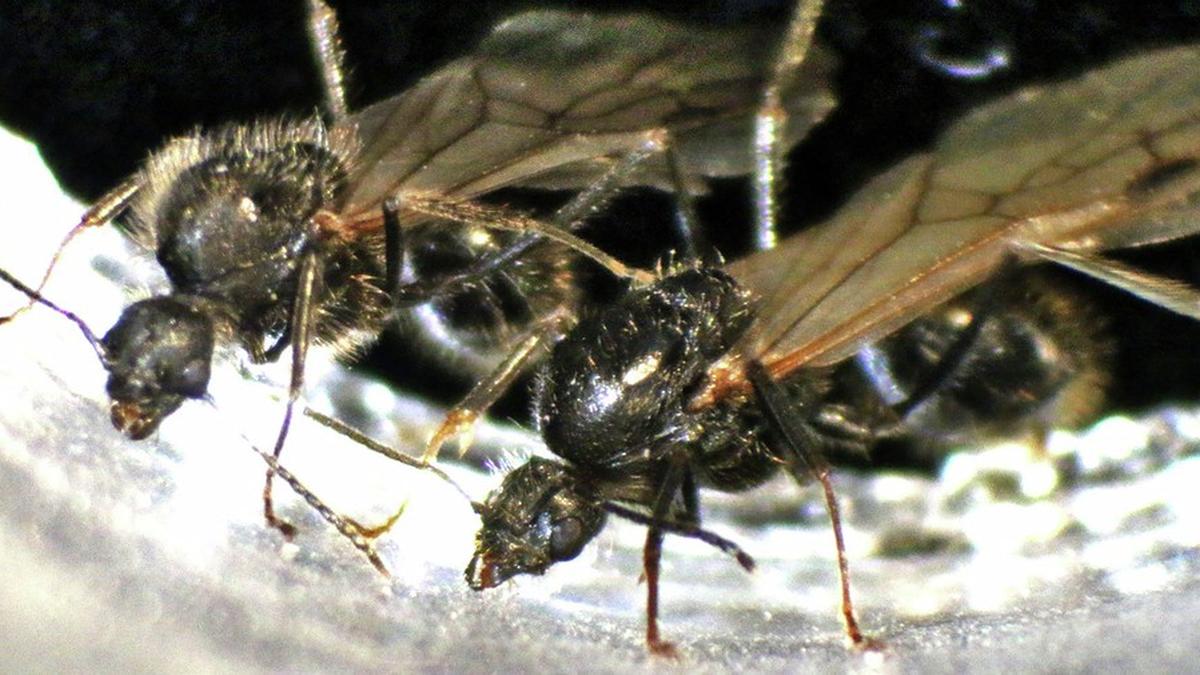
Researchers have discovered a remarkable case of an ant queen producing male offspring belonging to two distinct species, challenging existing understanding of ant reproduction. This finding offers new insights into ant breeding strategies and species evolution.
Scientists discover an ant queen producing male offspring from two species, revealing unique reproductive strategies and evolutionary insights in ants.
In a groundbreaking discovery published on November 2, 2025, scientists have documented an unusual reproductive phenomenon in ants where a single queen produces male offspring of two separate species. This unprecedented finding sheds new light on the complexities of ant reproduction and evolutionary biology, potentially altering the scientific community’s understanding of species boundaries and genetic inheritance in social insects.
The curious case involves a queen from the genus of ants known for their complex social structures and breeding systems. Researchers observed that this queen did not limit her male progeny to her own species but instead produced sons identifiable as belonging to two distinct sibling species. This dual-species offspring production is rare and had not been reported before in natural environments.
The study was conducted by a team of entomologists and evolutionary biologists who collected and analyzed ant colonies from a specific habitat known for its biodiversity. Genetic testing and morphological examinations confirmed the mixed-species lineage of the male ants. Scientists hypothesize that this reproductive strategy may be an adaptation for maximizing genetic diversity or ensuring colony survival under varying environmental pressures.
Experts believe that the queen’s ability to produce male ants from two species could influence mate selection dynamics and colony structure. The implications extend to understanding hybridization events and the mechanisms that maintain species barriers within eusocial organisms.
“This remarkable discovery challenges the traditional view of species as discrete units and demonstrates the complex reproductive strategies ants employ,” said Dr. A. Kumar, lead author of the study. “Our findings open avenues for further research into how these processes impact evolution and ecological interactions.”
The discovery also raises questions about the role of reproductive plasticity in social insects and how such mechanisms can drive speciation or genetic exchange across boundaries. Further research is needed to assess the prevalence of such cases and their evolutionary significance.
Concluding, the incident of an ant queen producing sons from two species provides a fresh perspective on the adaptability and reproductive biology of ants. It highlights the importance of continued research into insect biodiversity and reproductive strategies, which could have broader implications for ecology and evolutionary science.