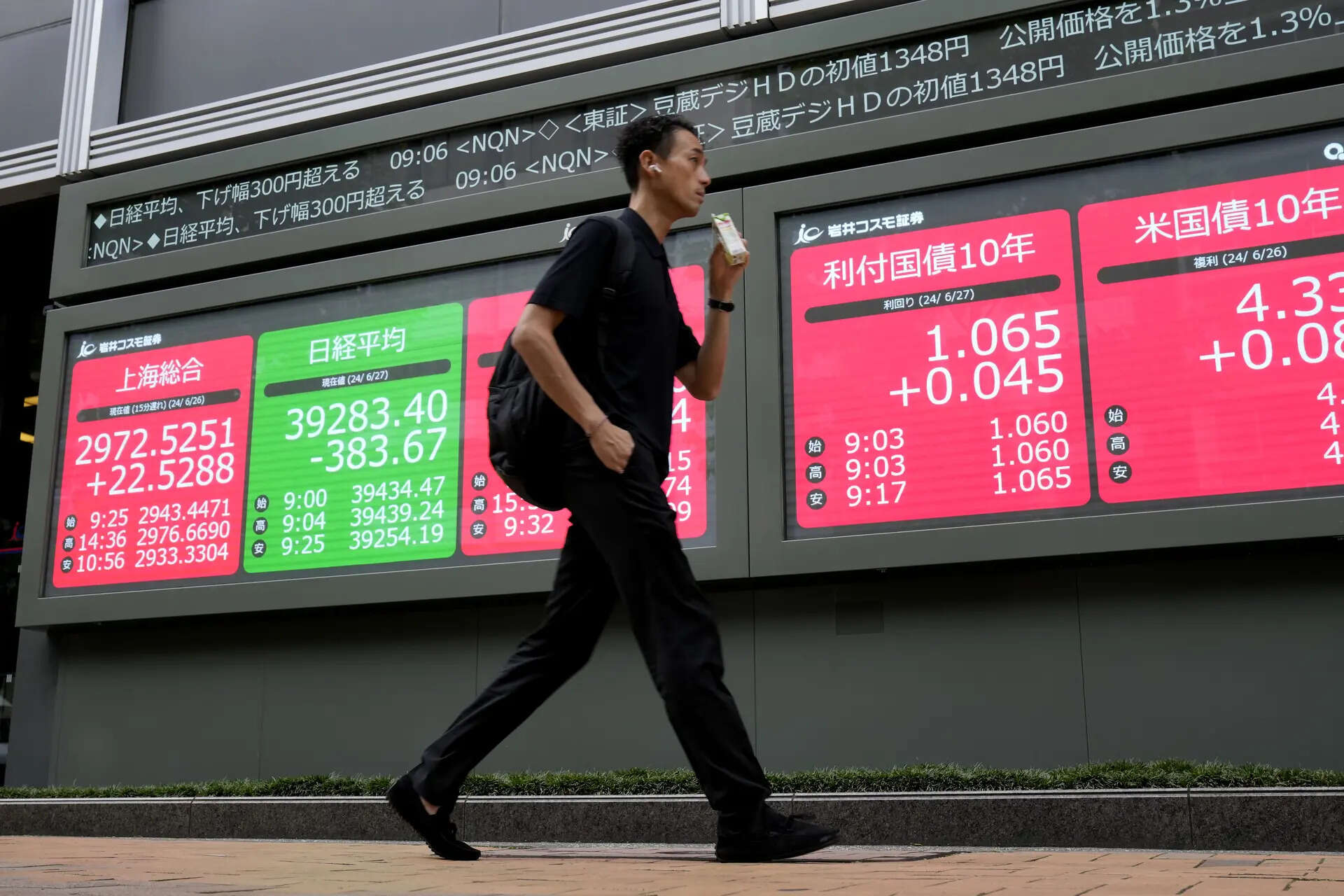
Asian stock markets tumbled on Thursday as investor sentiment was dampened by substantial losses on Wall Street the previous day. The Hang Seng Index fell over 240 points, while South Korea’s Kospi declined by 2.4%, reflecting concerns over global economic outlook and corporate earnings.
Asian stocks fell sharply as Wall Street losses weighed on markets; Hang Seng down 240+ points and Kospi falls 2.4% amid economic uncertainty.
Asian stock markets experienced significant declines on Thursday, tracking the sharp losses observed on Wall Street amid growing investor caution. The Hang Seng Index (HSI) in Hong Kong dropped more than 240 points, while South Korea’s Kospi index slid by 2.4%, indicating widespread risk aversion across regional equities.
The downturn in Asian markets came after the Dow Jones Industrial Average and the S&P 500 posted steep losses on the previous day, driven by increased worries about inflation pressures and uncertain corporate earnings forecasts. Traders and investors appeared to react to renewed concerns over the global economic outlook, exacerbated by mixed signals from recent economic data in the United States and China.
In Hong Kong, the HSI closed at approximately 18,000 points, losing roughly 1.3% of its value as financial and technology sector stocks were particularly hard hit. Analysts noted that mounting fears regarding potential interest rate hikes by the Federal Reserve and slower-than-expected growth in key markets contributed to the market’s negative momentum.
South Korea’s Kospi, one of Asia’s leading benchmarks, registered its sharpest drop in several weeks with a 2.4% decrease, influenced by declines in semiconductor and export-heavy industries. The region’s electronics firms, which have significant exposure to global demand fluctuations, were especially vulnerable to the current market sentiment.
Other major Asian markets, including Japan’s Nikkei 225 and Australia’s ASX 200, also posted losses following similar patterns of investor caution. The Nikkei slid by 1.1%, while the ASX 200 fell by around 1.5%, reflecting broader concerns about global trade tensions and the potential impacts on corporate profitability.
Market participants are now closely monitoring upcoming economic reports and corporate earnings releases for clearer indications of the economic trajectory. Investors remain particularly attentive to the Federal Reserve’s policy statements and China’s stimulus measures, which are expected to play crucial roles in shaping market direction in the near term.
Despite the current volatility, some analysts caution against interpreting the sell-off as a sign of a prolonged downturn, emphasizing that market corrections can create buying opportunities for long-term investors. However, the prevailing climate is one of cautious risk-taking as traders weigh multiple uncertain factors influencing the global economy.
In summary, Asian equity markets declined markedly on November 7, 2025, mirroring Wall Street’s losses triggered by economic uncertainties and inflation concerns. The Hang Seng Index eased over 240 points, and the Kospi index dropped 2.4%, as investors navigated a complex landscape of geopolitical, economic, and monetary policy developments.