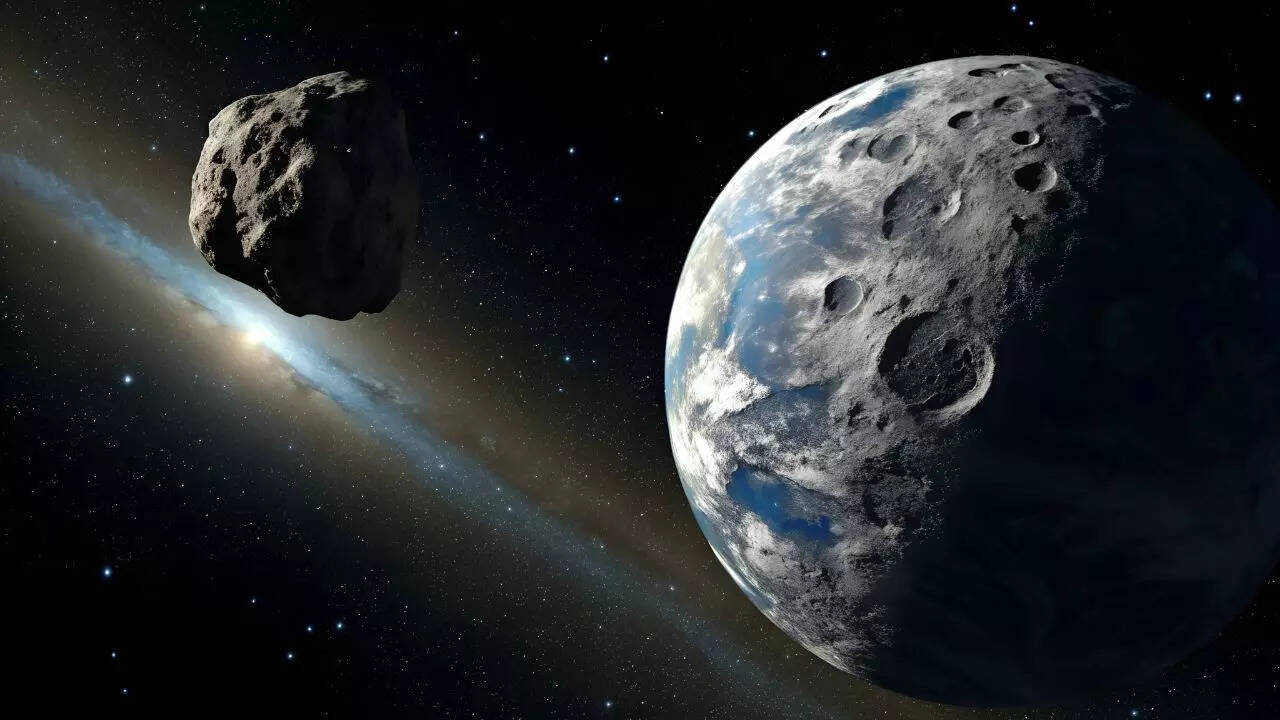
Astronomers have identified asteroid 2025 SC79, a 700-metre-wide space rock moving at remarkable speed inside Venus’ orbit. Completing an orbit around the Sun every 128 days, it is the second fastest known asteroid, advancing our understanding of near-Sun objects and their orbital dynamics.
Asteroid 2025 SC79, 700 metres wide and second fastest, races around the Sun inside Venus’ orbit every 128 days, enhancing knowledge of near-Sun objects.
Astronomers have recently detected asteroid 2025 SC79, a significant celestial object approximately 700 metres in diameter, moving rapidly inside the orbit of Venus. This newly spotted asteroid completes its revolution around the Sun in just 128 days, marking it as the second fastest asteroid known to science.
Discovery and Characteristics
The asteroid 2025 SC79 was identified during routine observations aimed at tracking near-Earth and inner solar system objects. Positioned within the orbit of Venus, which takes around 225 Earth days to circle the Sun, 2025 SC79 stands out due to its remarkably short orbital period of 128 days. This speed ranks it just behind the fastest known asteroid, highlighting the unique dynamical conditions closer to the Sun.
Measuring approximately 700 metres in diameter, 2025 SC79 is considerably large compared to many near-Earth asteroids. Its relatively fast orbit suggests interesting gravitational interactions as well as thermal effects from proximity to the Sun, factors that are currently under detailed study by astronomers worldwide.
Orbital Dynamics and Significance
Orbiting inside Venus’ path means 2025 SC79 is subject to intense solar radiation and gravitational forces from the inner planets. These conditions contribute to the asteroid’s high velocity and complex orbital path. Studying such asteroids offers critical insights into the population of near-Sun objects, which are less frequently observed due to observational challenges posed by the Sun’s glare.
Dr. Anita Deshmukh, a planetary scientist involved in the discovery, explained, “Asteroid 2025 SC79 is a valuable target for understanding the orbital mechanics of small bodies close to the Sun. Its speed and orbit provide clues about how such objects evolve over time under solar influence, and how potentially hazardous objects can shift trajectories.”
Implications for Planetary Science and Monitoring
The identification of fast-moving asteroids like 2025 SC79 inside Venus’ orbit has implications for planetary defense as well as scientific inquiry. By refining detection methods and expanding knowledge of such bodies, astronomers can better predict asteroid paths and potential Earth encounters.
This discovery also underscores the advancements in observational technology that now permit the detection of small and fast-moving asteroids closer to the Sun than ever before. Ongoing monitoring ensures that updated orbital data will be available, contributing to the broader effort to catalogue and understand solar system objects.
Conclusion
The spotting of 700-metre asteroid 2025 SC79 inside Venus’ orbit, completing a solar orbit in 128 days, adds a significant chapter to the study of near-Sun asteroids. Its speed, size, and trajectory provide scientists with critical data to enhance comprehension of asteroid behaviors close to the Sun, as well as improve future tracking and planetary safety initiatives.