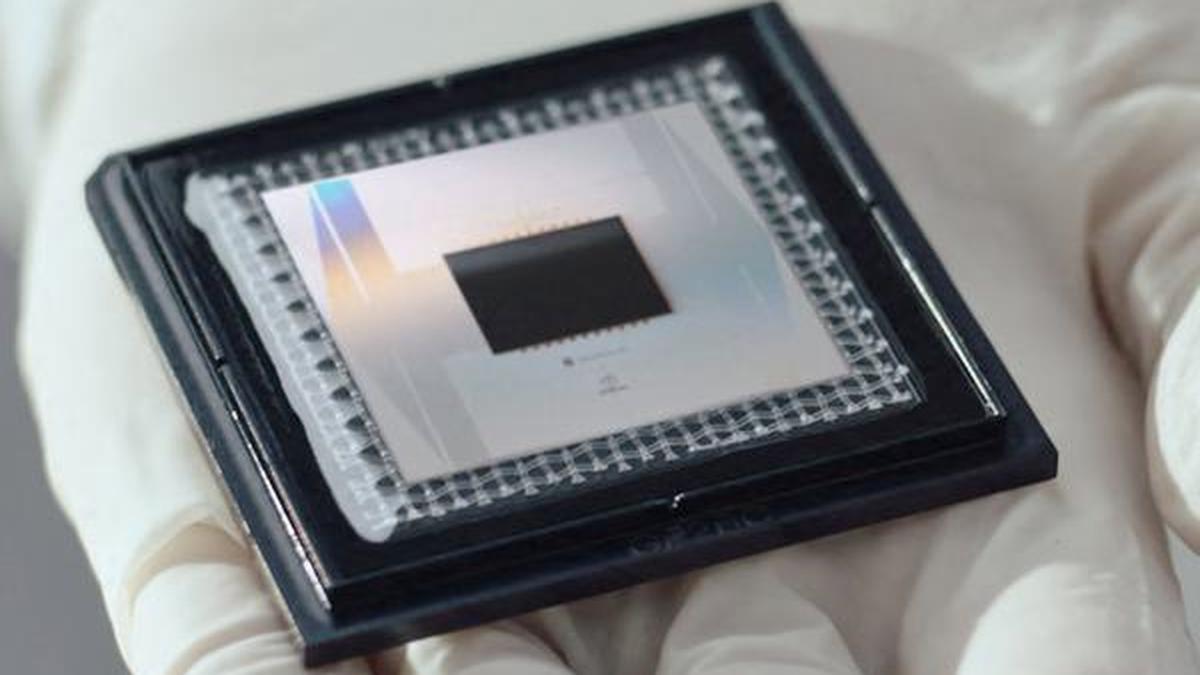
Google has announced achieving a verifiable quantum advantage using its latest Willow quantum chip, marking a significant milestone in quantum computing. The company claims this breakthrough demonstrates a clear computational superiority over classical supercomputers on a specific complex problem.
Google’s Willow quantum chip achieves the first verifiable quantum advantage, outperforming classical supercomputers in complex computations.
In a major advancement for quantum computing, Google has announced that its Willow quantum chip has achieved the first verifiable quantum advantage. The claim, made public on October 22, 2025, describes the chip’s ability to perform certain complex computations exponentially faster than the world’s most powerful classical supercomputers. The test was conducted in Google’s research facilities and verified through rigorous benchmarking to confirm the quantum chip’s superiority.
Quantum advantage, a term used to define the point at which quantum computers can outperform classical computers on a particular task, has been a highly anticipated milestone in the development of the technology. Google’s announcement positions the Willow chip as the first device to achieve this feat in a verifiable and reproducible manner, a leap forward in the race to demonstrate quantum supremacy.
The Willow chip incorporates several innovations over Google’s previous quantum systems, including larger qubit counts and improved error correction, enabling more stable and reliable quantum computations. According to Google’s research team, these advancements allowed the chip to solve complex optimization problems and simulate quantum phenomena exponentially faster than classical methods.
“This achievement validates the enormous potential of quantum computing and represents a critical step toward practical applications,” said Dr. Maya Rodriguez, lead scientist on the project. “Our Willow chip’s performance opens new possibilities for research areas such as materials science, cryptography, and complex system modeling that classical computers struggle to handle.”
The verification process included multiple independent analyses and comparisons with classical supercomputers running the same algorithms. The results consistently showed that the Willow chip completed tasks in minutes that would take classical machines thousands of years, highlighting a clear computational advantage.
Industry experts have acknowledged the announcement as a landmark event, but also caution that significant challenges remain before quantum computing becomes widely accessible or commercially viable. Issues such as scalability, noise, and error rates continue to be major hurdles in broader adoption.
Despite these challenges, Google’s breakthrough invigorates the quantum computing field, pushing other technology companies and research institutions to accelerate their quantum research and development. The achievement also underscores the strategic importance of quantum technology in global technology infrastructure and future innovation.
In summary, Google’s Willow quantum chip marks a pivotal moment in computing history by delivering the first verifiable quantum advantage, showcasing the practical potential of quantum processors to outperform classical computation in specialized tasks. This development promises to accelerate quantum research and could lead to revolutionary applications in multiple scientific and industrial domains.