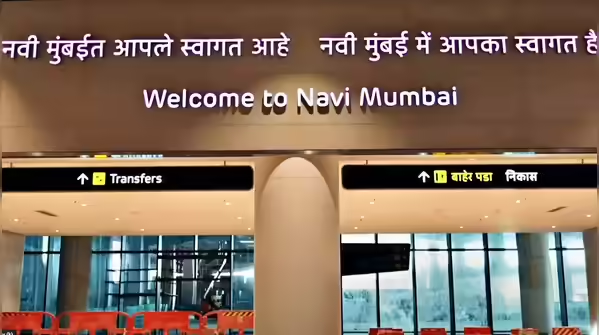
Prime Minister Narendra Modi formally inaugurated the Navi Mumbai International Airport on October 8, 2025, launching Mumbai’s second international airport. The greenfield facility in Ulwe is designed to relieve congestion at Chhatrapati Shivaji Maharaj International Airport and is built with modern architecture, scalability, and multimodal connectivity in mind.”
Mumbai has entered a new phase in aviation today, as Prime Minister Narendra Modi inaugurated the Navi Mumbai International Airport (NMIA) on October 8, 2025. The event in Ulwe, Raigad district marked the launch of Mumbai’s second international airport — India’s largest greenfield aviation project — intended to ease pressure on the city’s existing airport and support the region’s future growth.
A New Gateway for Mumbai The NMIA sits approximately 37 km from South Mumbai and is positioned to complement the overburdened Chhatrapati Shivaji Maharaj International Airport (CSMIA). Built under a public–private partnership (PPP) led by the Adani Group, the project carries a reported cost of ₹19,650 crore. In the first phase, NMIA will feature a single runway and terminal capable of handling about 20 million passengers annually, with scope for future expansion to accommodate up to 90 million. Airlines including IndiGo and Akasa have already indicated plans to operate from the new airport. The airport aims to handle up to 22 flights per hour at full capacity in Phase 1.
Design, Architecture and Passenger Facilities
One of NMIA’s most striking features is its lotus-inspired architectural design. The terminal is supported by 12 petal-like sculptural columns and 17 mega columns, lending both aesthetic appeal and structural support. Inside, the airport is equipped with 66 check-in counters, 29 aerobridges, 22 self-baggage drops, and 10 bus boarding gates. The design also incorporates smart systems for efficient operations and passenger experience. Architecturally, it is being compared with major global hubs given its planned scalability and sustainability features. The airport is expected to adopt solar power generation, advanced digital systems, and sustainable building practices. Connectivity and Multimodal Integration
A key aspect of NMIA’s development is multimodal connectivity. Plans call for integration with road, metro, rail, and even water-taxi services. The Mumbai Trans Harbour Link, coastal roads, elevated corridors, and metro extensions are expected to reduce travel time between South Mumbai and Ulwe significantly. In addition, the Ulwe–Panvel area is slated for infrastructure upgrades to support seamless access. The airport is also India’s first to plan for water-taxi operations. This novel service is part of the broader push to integrate last-mile access in multiple forms.
Strategic and Operational Impacts with the NMIA now operational, Mumbai becomes one of the few cities globally to host two international airports, joining the ranks of London, New York, and Dubai in the twin-airport model. This model is expected to relieve congestion at the existing airport, optimize route allocation, and expand capacity for new domestic and international services. Air India group has announced it will launch 20 daily departures initially via Air India Express, connecting 15 Indian cities, and aims to scale up to 55 daily departures (including international flights) by mid-2026. Campbell Wilson, CEO & MD of Air India, expressed commitment to the project: “We look forward to commencing operations at NMIA as Mumbai joins the league of world cities with more than one airport.” Arun Bansal of Adani Airport Holdings noted that NMIA’s vision aligns with building a benchmark global aviation node. An early test milestone occurred in October 2024, when an Indian Air Force C-295 aircraft landed on the new south runway, signaling validation of runway systems, taxiways, and air traffic control readiness.
Challenges and Risk Mitigation despite the fanfare, NMIA faces challenges ahead. Safety concerns have been flagged over the presence of illegal slaughterhouses and waste disposal sites within 3 km of the runway a violation of DGCA norms that require a 10 km buffer. The NatConnect Foundation has warned that such sites could attract bird strikes and compromise safety. In response, NMIA officials have begun monthly inspections with local civic bodies, formed a subcommittee under the Aerodrome Environment Management Committee, and initiated a year-long Wildlife Hazard Assessment Survey. Connectivity remains another hurdle: until road, metro, and water links are fully functional, passenger access may be constrained. Experts have also cautioned about operating costs and airline adoption in the early phases. Another point of contention is the naming of the airport. Officials in Maharashtra have announced plans to rename NMIA after the late D. B. Patil, pending approval from the Centre. As regional politics swirl, the naming decision is expected to be finalized in due course.
Looking Ahead phase 1 operations are expected to begin in December 2025, with further phases unfolding through the next decade. Over time, the airport is projected to handle up to 90 million passengers annually and 3.25 million metric tonnes of cargo, making it one of India’s largest aviation hubs. As Mumbai transitions into a dual-airport city, the debut of NMIA marks a structural shift in how the region manages air traffic flow. The coming years will test whether the infrastructure, operational integration, and airline uptake can deliver on the ambitious promise of decongestion, enhanced connectivity, and economic uplift for the Mumbai Metropolitan Region.
Conclusion The inauguration of Navi Mumbai International Airport on October 8, 2025, ushers in a landmark moment for India’s aviation infrastructure. Positioned to decongest Mumbai’s existing airport and support future growth, NMIA introduces advanced architecture, passenger amenities, and multimodal connectivity. While challenges remain in safety, access, and scaling operations, the airport’s phased expansion plan and strategic importance indicate that Mumbai’s twin-airport ambition has now moved into reality.