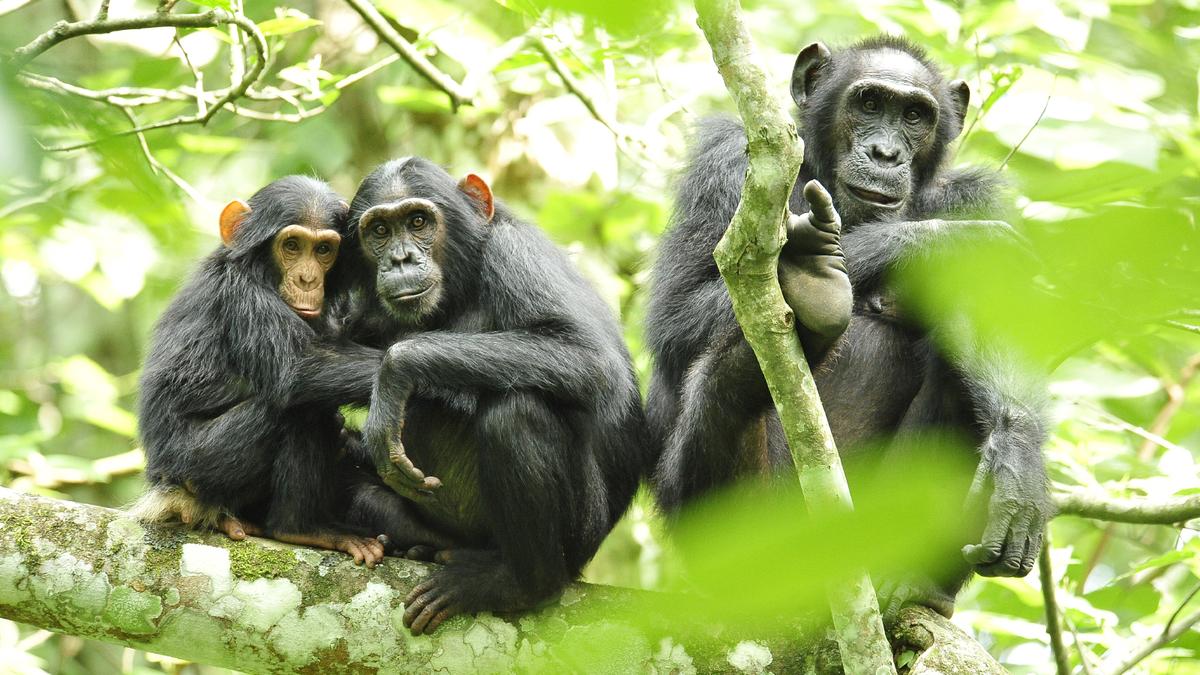
A recent study demonstrates that chimpanzees possess the ability to reason through their beliefs, suggesting advanced cognitive functions similar to humans. The research sheds light on primate intelligence and challenges previous assumptions about animal reasoning capabilities.
A new study reveals chimpanzees reason through their beliefs, showcasing advanced cognitive abilities similar to humans and reshaping our understanding of primate intelligence.
In a groundbreaking new study published on November 24, 2025, researchers have found compelling evidence that chimpanzees reason through their beliefs, highlighting an advanced level of cognition previously attributed mainly to humans. Conducted by a team of primatologists and cognitive scientists, the research provides fresh insight into the mental processes of our closest evolutionary relatives, deepening understanding of primate intelligence.
The study involved a series of carefully designed experiments testing chimpanzees’ ability to evaluate and act upon their beliefs in controlled scenarios. The primates were observed displaying behaviors that indicated not just instinctual reactions but deliberate reasoning based on what they believed to be true in given situations. This discovery presents a significant shift in the scientific perspective on primate reasoning capabilities.
“Our results indicate that chimpanzees are capable of forming and using beliefs to guide their decision-making, much like humans do,” said Dr. Anita Sharma, lead author and cognitive scientist at the University of Cambridge. “This challenges the long-held notion that only humans reason through beliefs and expands our understanding of animal cognition.”
Prior to this research, studies on animal cognition largely focused on observable behaviors and problem-solving skills without definitive proof of belief-based reasoning. The new findings suggest that chimpanzees not only process information but also mentally represent and weigh different possible outcomes based on their beliefs about the environment and other individuals.
The methodology employed included presenting chimpanzees with choice-based tasks involving hidden rewards and competing individuals with varying knowledge states. The primates consistently made decisions that implied an appreciation of others’ beliefs and intentions, reflecting what cognitive scientists term “theory of mind.” This ability to infer the mental states of others has been considered a hallmark of human social cognition.
Experts not involved in the study have praised its rigorous approach. Dr. Miguel Hernandez, a primatologist at Stanford University, noted, “This research adds a vital piece to the puzzle of animal intelligence. Understanding that chimpanzees reason through their beliefs brings us closer to uncovering the evolutionary origins of human cognition.”
This study was carried out at several primate research centers in Africa and Europe, involving dozens of chimpanzees in naturalistic and laboratory settings to validate findings across different contexts. The consistency of results across diverse environments strengthens the validity of the conclusions.
The implications of these findings extend beyond academic interest. Recognizing chimpanzees’ advanced reasoning abilities may influence conservation strategies, animal welfare policies, and ethical considerations regarding primates in captivity and the wild. Such insights urge a reevaluation of how societies relate to and protect these intelligent animals.
In conclusion, the study published on 24 November 2025 reveals that chimpanzees use reasoning based on their beliefs, exhibiting cognitive functions that parallel those of humans. By demonstrating belief-based reasoning and theory of mind capabilities, the research significantly advances the scientific understanding of primate intelligence and opens new avenues for exploring the evolution of human cognition.