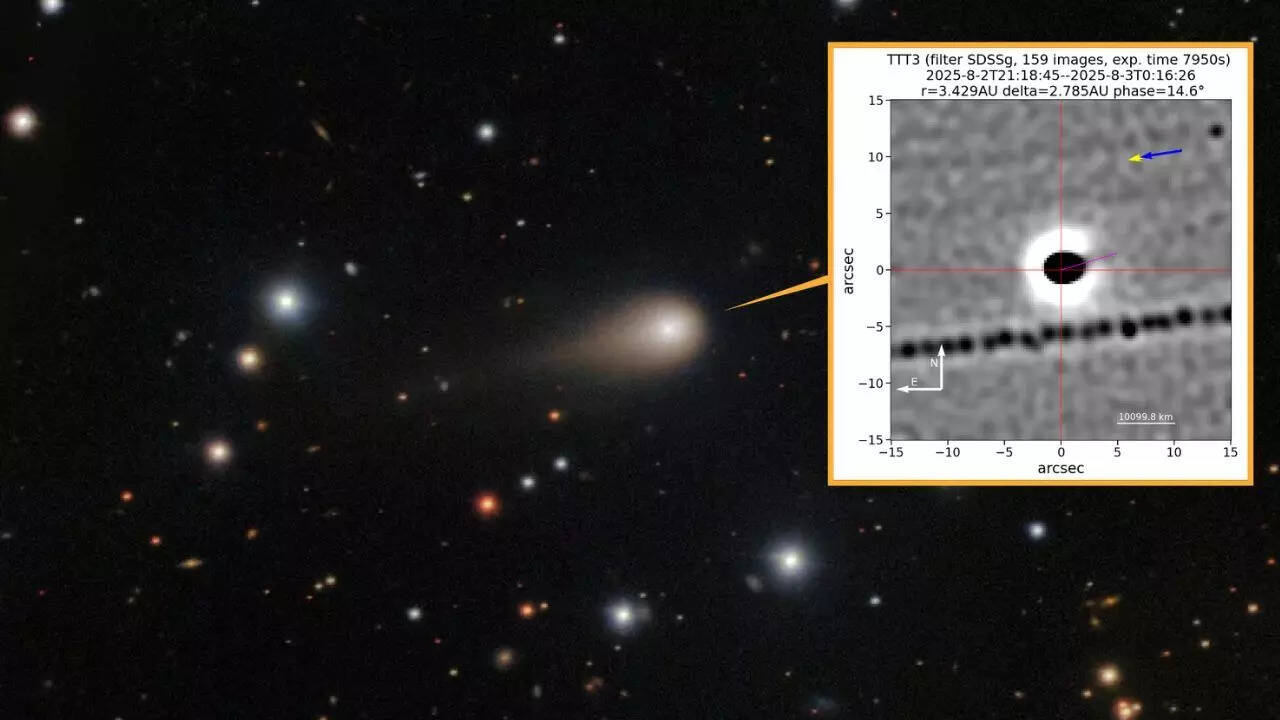
Astronomers have classified the celestial object 3I/ATLAS as a rare ‘Black Swan’ due to its atypical trajectory through the solar system. Researchers continue to monitor its unusual path for potential clues indicating extraterrestrial origins or phenomena.
Astronomers classify 3I/ATLAS as a rare ‘Black Swan’ object with an unusual path, monitoring for clues about its interstellar origin and possible alien connections.
Scientists worldwide have turned their attention to 3I/ATLAS, a recently observed interstellar object exhibiting an unconventional trajectory as it passes through the solar system. First detected earlier in 2025, this object has been designated a rare ‘Black Swan’ phenomenon by researchers due to its highly unusual and unpredictable path. The term ‘Black Swan’ refers to events or findings that are unexpected and carry significant implications, underlining the exceptional nature of 3I/ATLAS. Observatories and astronomers from multiple countries are collaborating to monitor its course and gather data that may reveal important insights about its origin and composition. Unlike typical asteroids or comets native to our solar system, 3I/ATLAS approaches from interstellar space, which itself raises numerous scientific questions. “Its trajectory defies common orbital mechanics we observe in solar system bodies,” said Dr. Elena Ramirez, an astrophysicist at the European Southern Observatory. “This hints at forces or origins that challenge our current understanding.” Moreover, some scientists propose that subtle anomalies in 3I/ATLAS’s motion could suggest artificial characteristics or activities, sparking discussions about potential extraterrestrial technology or artifacts. However, the majority of experts caution that such interpretations require rigorous verification and emphasize the need for comprehensive spectroscopic and radar studies. Instruments across the globe have been tasked with continuous observation of 3I/ATLAS to track its speed, rotation, and material composition. Early spectral analyses indicate a mixture of elements uncommon in known solar system bodies, further fueling interest in its provenance. The scientific community remains measured yet intrigued, recognizing that 3I/ATLAS could offer unprecedented information about objects originating beyond our planetary neighborhood. As data collection progresses, researchers aim to publish findings detailing its characteristics and implications for astrophysics and planetary science. The study of 3I/ATLAS underscores the growing importance of monitoring near-Earth and interstellar objects to deepen humanity’s understanding of the universe and the potential presence of life or technology beyond Earth. Ongoing observation and analysis will be critical in unraveling the mysteries posed by this rare celestial visitor.