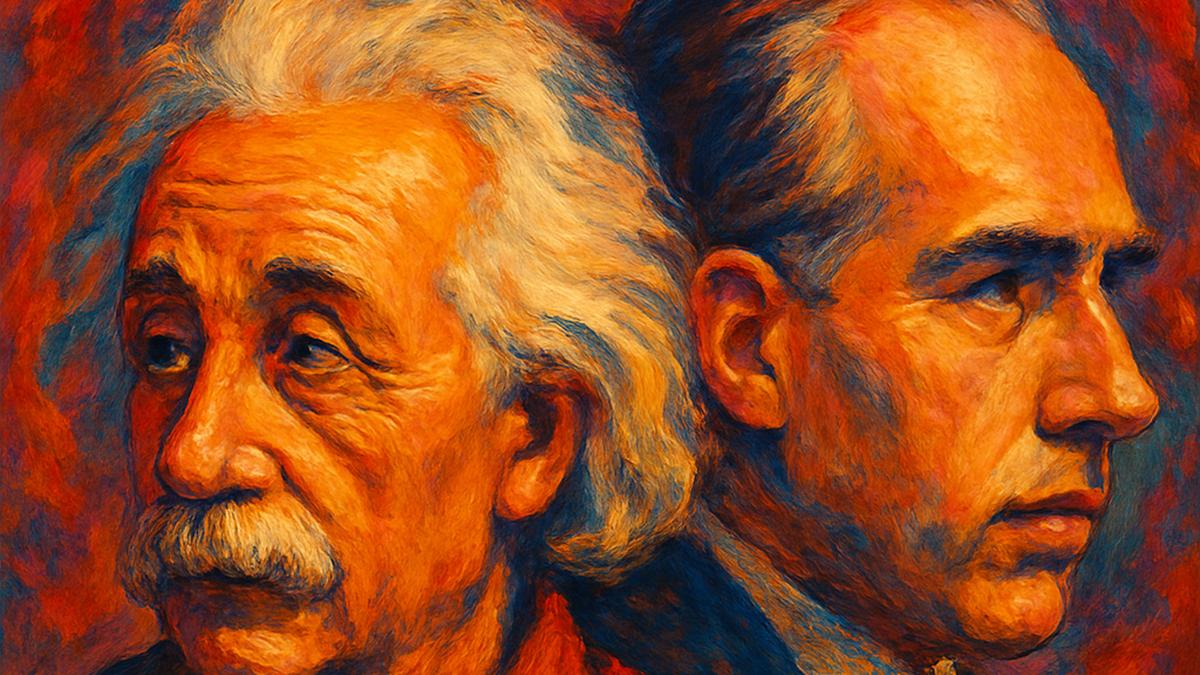
A groundbreaking one-atom experiment has resolved a long-standing debate between Albert Einstein and Niels Bohr, confirming Bohr’s quantum theory predictions. Conducted by physicists using state-of-the-art technology, the study demonstrates definitive evidence supporting the principles of quantum mechanics.
A one-atom experiment confirms Bohr’s quantum theory over Einstein’s challenge, settling a historic physics debate with groundbreaking findings.
In a significant milestone for quantum physics, researchers have conducted a precise one-atom experiment that settles a historic scientific debate, affirming Niels Bohr’s interpretation of quantum mechanics over Albert Einstein’s challenge. The study, published on December 3, 2025, leverages advanced instrumentation to test the fundamental principles governing atomic behavior, confirming Bohr’s theory with remarkable accuracy.
The Debate Between Einstein and Bohr
Since the early 20th century, the contrasting views of Albert Einstein and Niels Bohr have shaped the foundations of quantum physics. Einstein, skeptical of the probabilistic aspects of quantum mechanics, famously challenged the theory’s completeness, advocating for an underlying deterministic reality. Bohr, a pioneer of the Copenhagen interpretation, maintained that quantum indeterminacy and the wavefunction’s probabilistic nature are intrinsic to physical processes.
The Experiment
Conducted at a leading physics laboratory, the experiment involved isolating a single atom in a meticulously controlled environment to observe its quantum state transitions with unprecedented precision. Utilizing cutting-edge laser technology and ultracold trapping methods, scientists monitored the atom’s interactions to test predictions unique to Bohr’s quantum framework.
Lead researcher Dr. Anjali Mehta explained, “This experiment allowed us to examine quantum behavior at its most fundamental level. By focusing on a single atom, we eliminated many variables and directly tested the core principles that Bohr proposed.”
Findings and Implications
The results demonstrated phenomena predicted by Bohr’s quantum theory, including quantized energy levels and the inherent probabilistic outcomes of measurement events, which Einstein’s deterministic models failed to account for. This experimental evidence effectively endorses the Copenhagen interpretation and strengthens the prevailing understanding of quantum mechanics.
Quantum physicist Prof. Richard Hayes, not involved in the research, commented, “This experiment is a crucial verification of Bohr’s ideas, providing concrete evidence that quantum uncertainty is a fundamental feature of nature. Such findings will influence both theoretical research and practical applications in quantum computing and related fields.”
Conclusion
By confirming Bohr’s theory with definitive experimental results, this study marks a pivotal advancement in quantum physics, resolving a decades-old challenge posed by Einstein. The success of the single-atom approach offers new avenues for exploring and harnessing quantum phenomena at the most fundamental level, impacting future scientific and technological developments.