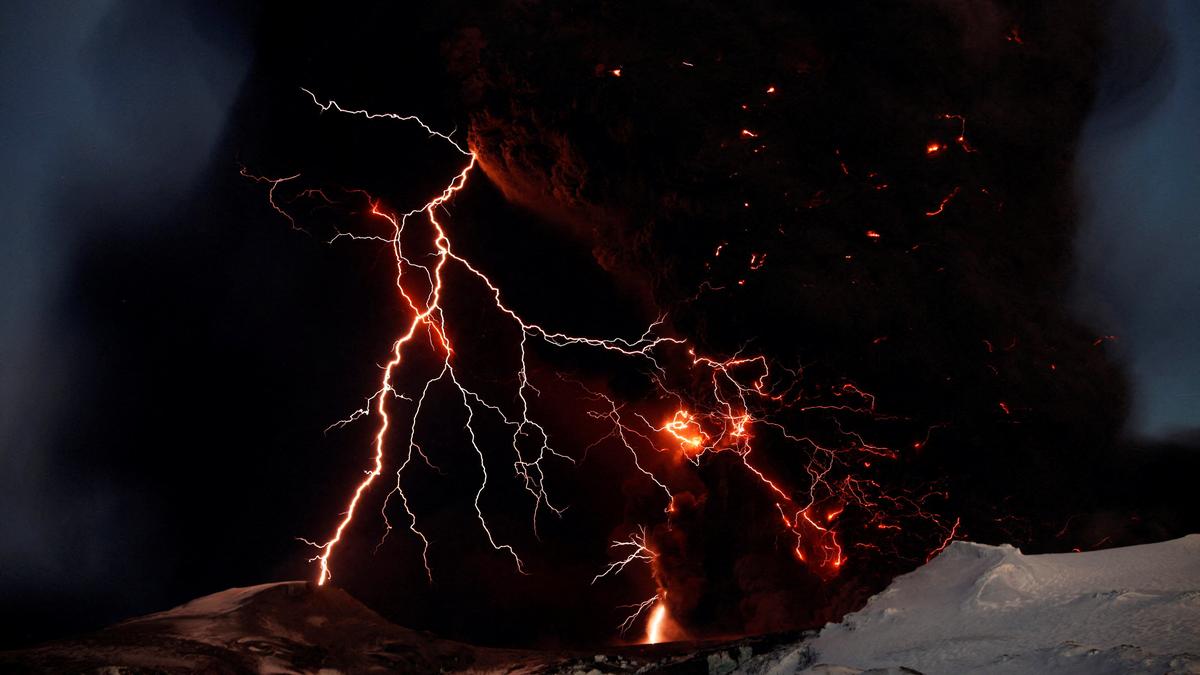
Volcanic lightning is a rare and striking natural phenomenon that occurs during volcanic eruptions when ash particles generate electrical charges. This article explores how volcanic lightning forms, its scientific significance, and notable observations worldwide.
Explore volcanic lightning, a natural phenomenon where lightning occurs within volcanic ash plumes during eruptions, its causes, and scientific importance.
Volcanic lightning is a captivating atmospheric event that occurs during volcanic eruptions, characterized by flashes of lightning within the ash plume emitted from an erupting volcano. This phenomenon has intrigued scientists and observers alike due to its rare occurrence and the complex processes behind its formation. The phenomenon was observed during several recent volcanic eruptions globally, highlighting its significance in understanding both volcanology and atmospheric electricity.
What is Volcanic Lightning?
Volcanic lightning refers to electrical discharges produced in the ash clouds created by volcanic eruptions. When a volcano erupts, it emits a mixture of hot gases, ash particles, and rock fragments into the atmosphere. These ash particles collide and rub against each other as they rise, generating static electricity. As charges build up within the ash plume, the resulting electrical field can become strong enough to cause lightning bolts, similar to those seen in thunderstorms.
How Does Volcanic Lightning Form?
The process behind volcanic lightning involves the charge separation generated by friction between ash particles. Scientists believe that both triboelectric charging — where particles exchange electrons during collisions — and fractoemission — the release of charged particles when rocks fracture — contribute to this electrification. As the charged particles accumulate inside the ash cloud, regions of opposite charge develop, leading to strong electric fields. When these fields exceed the air’s breakdown voltage, an electrical discharge occurs, producing visible lightning.
Observations and Scientific Insight
Volcanic lightning has been documented in numerous volcanic eruptions worldwide. Notable examples include the 2009 eruption of Mount Redoubt in Alaska and the 2010 eruption of Eyjafjallajökull in Iceland, both of which produced spectacular lightning displays that scientists captured using high-speed cameras and dedicated instruments. These observations have enhanced understanding of ash plume dynamics, eruption intensity, and atmospheric effects caused by volcanoes.
Scientific research into volcanic lightning aids in monitoring volcanic activity. Lightning detection systems complement traditional methods such as seismic monitoring and gas measurements by providing real-time data on ash plume development, which can be critical for aviation safety and hazard assessment. For example, the presence and intensity of volcanic lightning have been used as indicators of eruption phases and ash dispersal patterns.
Safety and Environmental Impact
Volcanic lightning poses inherent dangers, as it combines volcanic hazards with electrical discharges. Lightning strikes during eruptions can ignite fires or cause electrical interruptions in surrounding areas. Moreover, volcanic ash clouds containing charged particles can affect communication and navigation systems, emphasizing the importance of studying volcanic lightning to mitigate risks.
Conclusion
Volcanic lightning is a rare but scientifically valuable phenomenon that provides insights into the behavior of volcanic eruptions and atmospheric electricity. By understanding the mechanisms behind it, scientists can improve eruption monitoring and enhance public safety. Continued research and observation remain essential to unravel the complexities of volcanic lightning and its broader environmental implications.