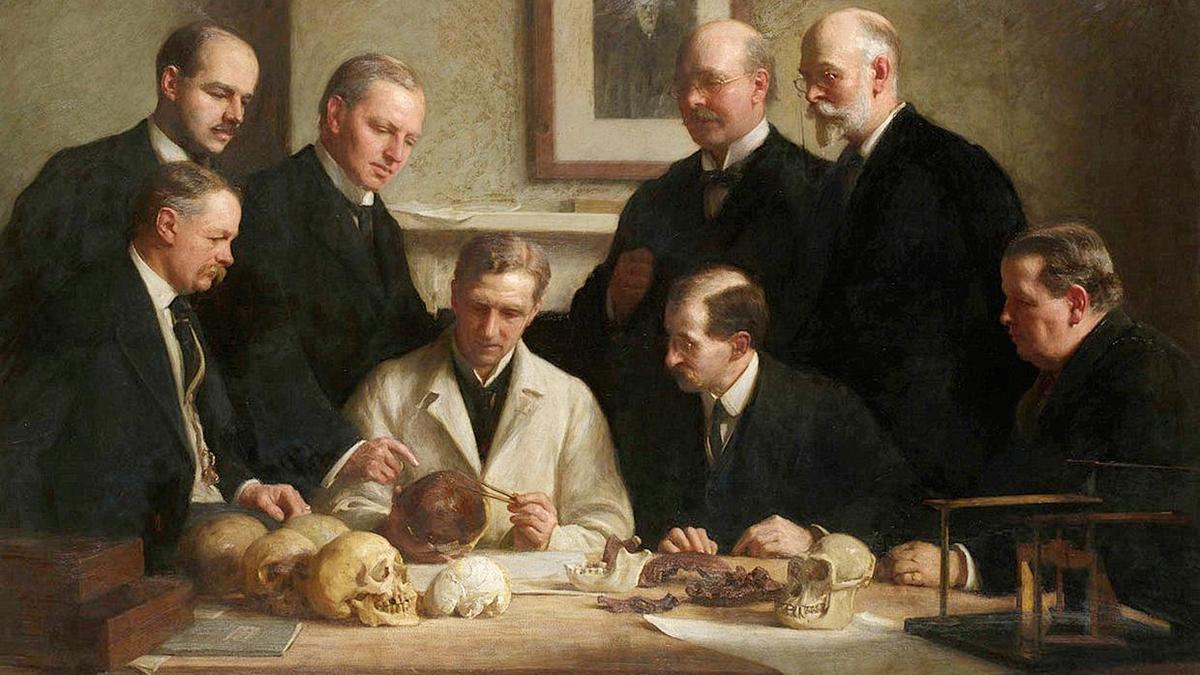
The Piltdown Man hoax, one of the most notorious archaeological frauds in history, involved fabricated fossil remains purported to be the ‘missing link’ in human evolution. Discovered in England in the early 20th century, the forgery misled scientists for decades before being conclusively exposed in the 1950s.
Explore the Piltdown Man hoax, archaeology’s biggest fraud, and its impact on the study of human evolution after decades of deception.
The story of the Piltdown Man represents one of the most significant deceptions in the field of archaeology and paleoanthropology. Discovered in 1912 near Piltdown, East Sussex, England, this supposed ‘missing link’ between apes and humans captivated the scientific community for over four decades. The fossils, found by amateur archaeologist Charles Dawson, were initially hailed as groundbreaking evidence of early human ancestors in Europe, but the truth behind their origin was far from genuine.
The discovery included fragments of a skull and jawbone which appeared to exhibit both human and ape-like features, seemingly bridging a gap in human evolutionary history. This find excited researchers eager to understand human origins and was widely publicized as a major scientific breakthrough. However, suspicion about the authenticity of the Piltdown fossils began to grow due to inconsistencies in the anatomical features and geological context.
In 1953, after extensive testing using more advanced scientific methods such as fluorine dating and anatomical analysis, British scientists Kenneth Oakley, Sir Wilfrid Le Gros Clark, and Joseph Weiner conclusively demonstrated that the Piltdown Man was a forgery. The skull was actually a human cranium of medieval origin, while the jawbone was from an orangutan, deliberately altered to fit the skull and artificially aged to appear ancient.
The motives behind this elaborate deception remain partly speculative, but it is widely believed that Charles Dawson perpetrated the fraud to gain prestige and recognition within the scientific community. The hoax significantly impacted paleoanthropology, misleading research and delaying authentic discoveries about human evolution.
Despite the Piltdown Man’s exposure as a fraud, the incident has provided valuable lessons for the scientific community about the importance of critical scrutiny, rigorous testing, and skepticism in accepting new findings. It also highlighted how confirmation bias and nationalistic pride can influence scientific judgment.
Today, the Piltdown Man remains a cautionary tale within archaeology and anthropology. The forgery serves as a reminder of the critical role that scientific verification plays in advancing knowledge and preserving the integrity of historical research. The case continues to attract interest both within academia and among the general public as a dramatic episode in the history of science.
In summary, the Piltdown Man hoax was a fabricated archaeological find that misled scientists for over 40 years. Uncovered in England by Charles Dawson in 1912, it falsely claimed to represent an evolutionary ‘missing link.’ Its eventual exposure in 1953 underscored the need for meticulous scientific validation and remains a notable example of one of archaeology’s biggest frauds.