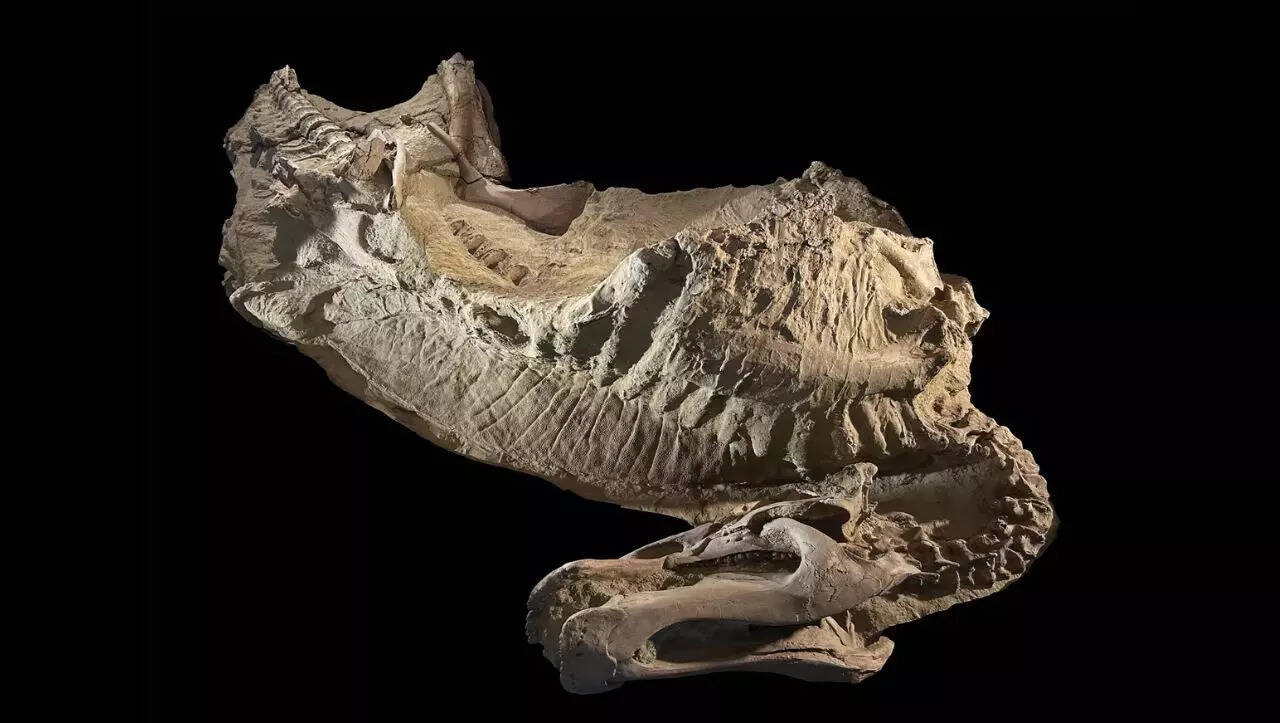
Scientists have uncovered the first mummified hooved dinosaur in the Wyoming Badlands, providing unprecedented detail on its skin and anatomy. This rare find is set to reshape current understandings of dinosaur evolution and preservation.
Scientists discover first mummified hooved dinosaur in Wyoming Badlands, offering new insights into dinosaur evolution and prehistoric life.
In a groundbreaking discovery announced on October 30, 2025, paleontologists have identified the first mummified hooved dinosaur in the Wyoming Badlands. This remarkable fossil, remarkably preserved with skin and other soft tissues intact, offers a unique glimpse into prehistoric life and challenges existing evolutionary models.
The fossil was excavated by a research team working in the arid, rocky terrain of Wyoming’s Badlands, a region known for yielding significant dinosaur remains. Unlike typical fossils that mainly preserve bones, this specimen retains mummified skin and anatomical structures that have rarely survived the passage of millions of years.
Experts say the dinosaur belonged to a group characterized by hooves rather than the more common clawed feet, a feature that has implications for how these creatures moved and interacted with their environment. The find helps paleontologists better understand locomotion and evolutionary traits in herbivorous dinosaurs.
Dr. Emily Hughes, lead researcher from the University of Wyoming, explained, “The preservation quality is unlike anything we’ve encountered before for this particular species. It allows us to study skin texture, musculature, and potentially even pigmentation, making it a treasure trove for evolutionary biology.”
The mummification suggests rapid burial and specific environmental conditions, which prevented decay and scavenging. This challenges previous assumptions about fossilization processes in such climates and opens new avenues for discovering similar specimens worldwide.
Such preserved soft tissues can offer vital data that bones alone cannot, including insights into physiology, behavior, and adaptations that helped dinosaurs thrive in their habitats. This discovery could potentially redefine hypotheses about dinosaur diversity and evolutionary history during the late Cretaceous period.
The Wyoming Badlands have long been a hotspot for dinosaur fossils, but this find stands out due to its exceptional state, prompting renewed interest in the area. Researchers aim to continue detailed analyses, including advanced imaging and chemical testing, to extract further information from the specimen.
As paleontology advances with new technologies, finds like this mummified hooved dinosaur underscore the importance of preserving and studying fossil sites. The discovery not only enriches the scientific community’s understanding of prehistoric ecosystems but also captivates public imagination about Earth’s distant past.
In summary, the first-ever mummified hooved dinosaur discovered in Wyoming’s Badlands represents a landmark moment in paleontology. The fossil’s exceptional preservation provides fresh evidence on dinosaur anatomy and evolution, promising to inform scientific knowledge for years to come.