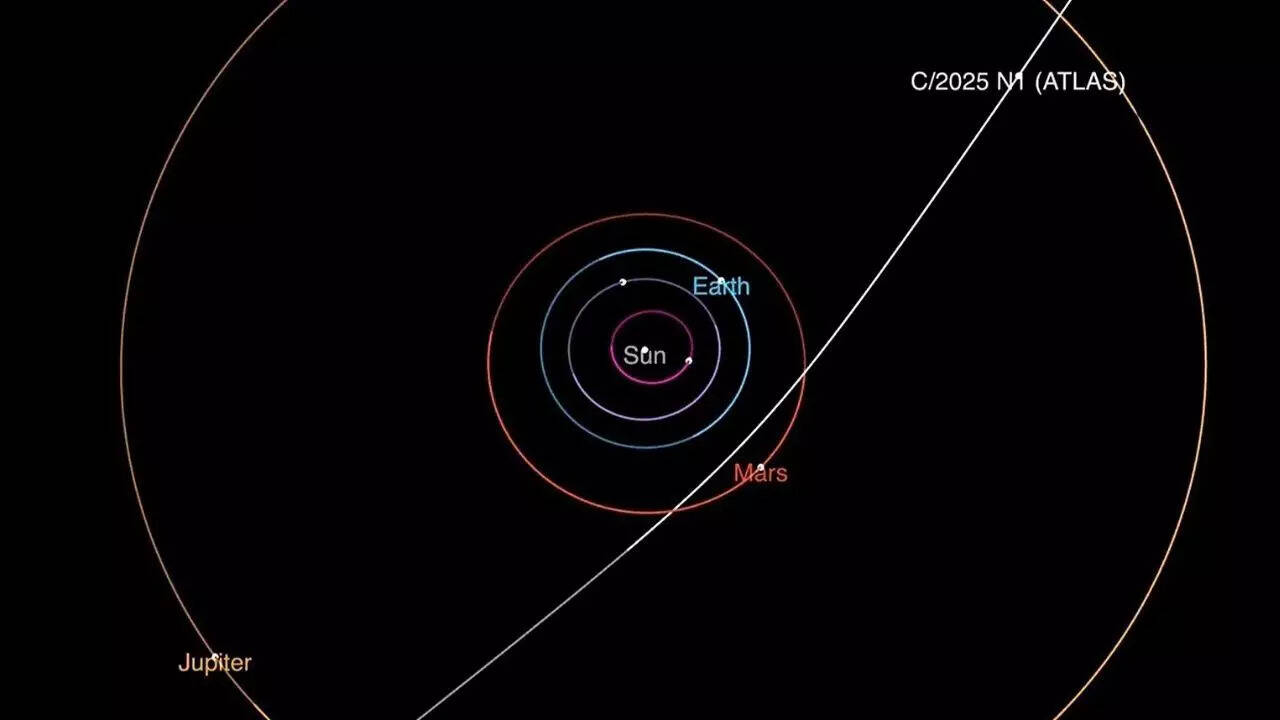
The recently detected interstellar visitor 3I/ATLAS, initially classified as a comet, exhibits unique characteristics that suggest it might play a role in protecting Earth from asteroid threats. Scientists are studying its trajectory and composition to understand its potential as a natural shield against space hazards.
3I/ATLAS, a rare interstellar object, may help protect Earth from asteroid threats as scientists study its unique trajectory and composition.
Scientists worldwide are keenly observing 3I/ATLAS, a rare interstellar object passing through our solar system, as new research suggests it could have a significant role in Earth’s defense against asteroid collisions. First detected earlier in 2025, 3I/ATLAS has drawn interest not only due to its uncommon origin from beyond the solar system but also because of its unusual physical properties that set it apart from typical comets or asteroids.
The discovery of 3I/ATLAS has revitalized study into interstellar objects—celestial visitors from beyond our solar neighborhood. Unlike usual cometary bodies, 3I/ATLAS showcases a trajectory and composition that hint at a more complex structure, leading some experts to hypothesize that it might serve as a natural shield by intercepting potentially hazardous asteroids en route to Earth.
Dr. Elena Martinez, an astrophysicist at the International Space Observatory, explained, “3I/ATLAS stands out because of its unusually stable orbit and material makeup. It’s comprised of dense, metallic elements uncommon in typical comets, suggesting it could withstand impacts and alter asteroid paths. This makes it a subject of interest for planetary defense strategies.”
The object’s passage near Earth’s vicinity is being tracked through advanced telescopes and space observatories globally. Detailed spectroscopic analysis indicates that 3I/ATLAS contains a mix of refractory materials and ices, blending characteristics of both comets and asteroids, which could contribute to its potential as a deflector of smaller near-Earth objects.
Historically, Earth has faced significant threats from space debris, with asteroid impacts posing a real danger to life and infrastructure. Current defense measures primarily focus on detection and possible intervention. The unique nature of 3I/ATLAS sparks interest in whether natural celestial bodies passing through our solar system can assist or complement artificial planetary defense systems.
“While it’s premature to categorize 3I/ATLAS as Earth’s silent protector definitively, understanding its properties and interactions with other near-Earth objects expands our knowledge about natural cosmic neighborhood dynamics,” said Prof. Samuel Greene from the Planetary Research Institute. “Further observation and modeling are essential to grasp its full potential.”
The exploration of 3I/ATLAS also provides valuable insights into interstellar matter and the processes shaping celestial bodies in different parts of the galaxy. As data collection continues, researchers hope to uncover the origins of such objects and their impacts on planetary systems they traverse.
With its unusual blend of cometary and asteroid traits, and its distinctive interstellar provenance, 3I/ATLAS challenges existing classifications and encourages a reevaluation of how space objects can influence Earth’s safety. The scientific community remains vigilant, combining observational data with theoretical modeling to unlock the mysteries of this enigmatic visitor.
As 3I/ATLAS moves beyond the solar system in the coming months, its potential legacy as a natural agent mitigating asteroid threats will be better understood. Until then, the object remains a compelling focus for ongoing planetary defense research and interstellar astronomy.