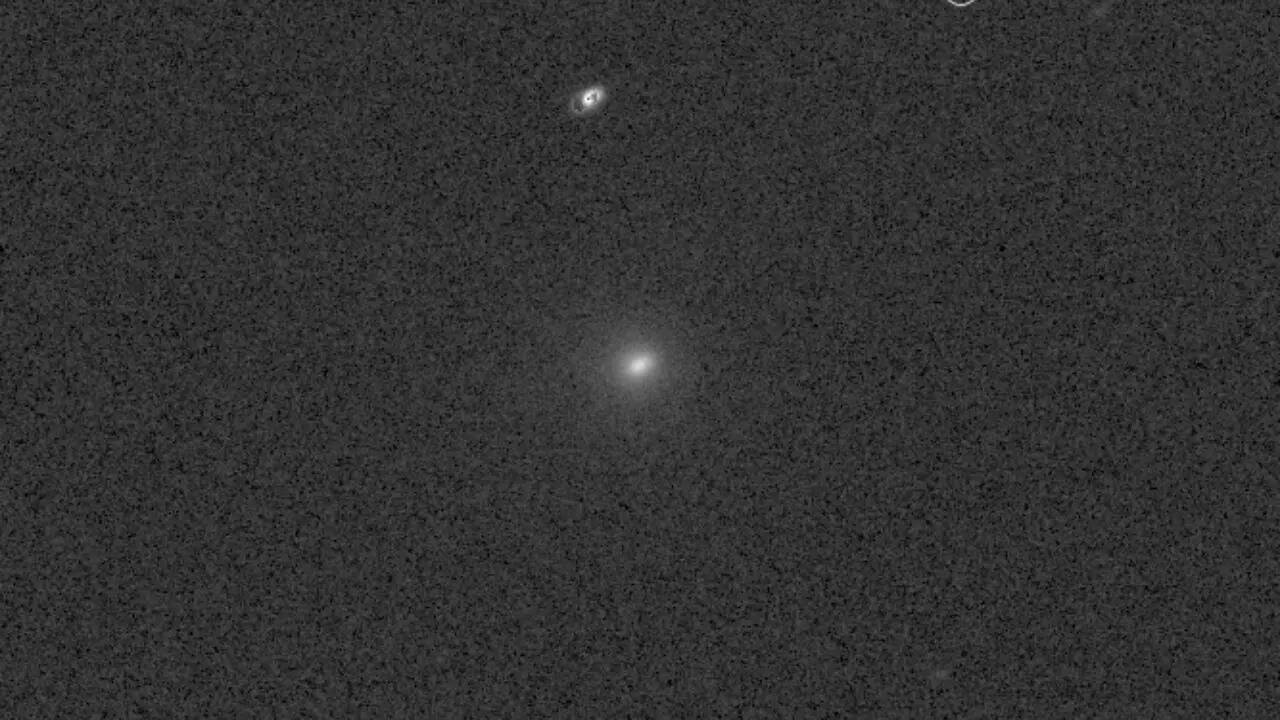
Interstellar comet 3I/ATLAS has been observed again after its close pass around the Sun, with astronomers capturing the first optical image post-solar swing. This significant observation provides new insights into the comet’s trajectory and physical characteristics as it journeys back into interstellar space.
Interstellar comet 3I/ATLAS reappears after solar swing with first optical images captured, providing key insights into its trajectory and composition.
Astronomers worldwide have successfully captured the first optical images of the interstellar comet 3I/ATLAS as it reemerged from behind the Sun following its close approach, marking an important milestone in the study of visitors from beyond our solar system. The comet, which was initially detected in early 2023, has been closely monitored since then due to its rare trajectory and origin from interstellar space.
3I/ATLAS made its closest approach to the Sun, known as perihelion, in late October 2025. During this period, the comet’s visibility was obscured by the Sun’s glare, making direct observations challenging. However, after the comet passed this solar swing, observatories equipped with advanced optical telescopes captured clear images, revealing the comet’s current state and pathway.
Interstellar comets like 3I/ATLAS are invaluable for researchers because they offer a unique glimpse into the composition and characteristics of materials from other star systems. Dr. Ayesha Malik, an astrophysicist at the Indian Institute of Astrophysics, commented, “Capturing optical images after perihelion allows us to analyze changes in the comet’s tail and nucleus, shedding light on how solar radiation affects its structure.”
The initial discovery of 3I/ATLAS was made by the Asteroid Terrestrial-impact Last Alert System (ATLAS), which has been instrumental in identifying near-Earth objects and transient celestial bodies. Since its discovery, astronomers have tracked the comet’s hyperbolic trajectory, confirming its interstellar origin – a trajectory indicating the comet is not gravitationally bound to our solar system.
Observations conducted post-solar swing are critical for understanding the comet’s physical properties, such as particle composition and outgassing behavior. These phenomena provide clues about its origin in a star system different from our own. Moreover, tracking 3I/ATLAS’ velocity and trajectory helps refine models predicting future paths of interstellar objects.
The returned optical images display a bright coma and a faint tail, characteristics typical of comets but also unique in revealing the object’s interaction with solar wind and radiation. Teams at multiple observatories, including those at Mauna Kea, Hawaii, and the European Southern Observatory, collaborated to collect and analyze the data promptly.
This event also highlights advancements in observational technology, enabling astronomers to perform detailed studies of transient objects despite challenging conditions such as their proximity to the Sun. The data obtained from 3I/ATLAS contributes not only to cometary science but also has broader implications for understanding the dynamics of interstellar matter and planetary system formation across the galaxy.
As 3I/ATLAS continues its outbound journey, it will eventually fade from view as it retreats into interstellar space. Scientists continue to monitor the comet for any unexpected activity or changes, eager to gather as much information as possible during its brief visit.
The observation of 3I/ATLAS after its solar swing marks a significant achievement in the field of astronomy, enhancing our knowledge of rare interstellar visitors and the complex dynamics they exhibit within our solar environment.