India’s Chandrayaan-2 mission has made a pioneering observation of how the Sun impacts the lunar surface, marking a first in space exploration. The Indian Space Research Organisation (ISRO) announced the findings on October 19, 2025, highlighting new insights into solar wind interactions with the Moon.
Chandrayaan-2 makes first direct observation of the Sun’s impact on the Moon, revealing new insights into solar wind interactions and lunar surface processes.
India’s Chandrayaan-2 mission has achieved a significant milestone by making the first-ever direct observation of the Sun’s impact on the lunar surface, according to the Indian Space Research Organisation (ISRO). The announcement was made on October 19, 2025, underscoring the mission’s continued contributions to lunar science and space exploration.
Chandrayaan-2, launched in July 2019, comprises an orbiter, lander, and rover designed to study the Moon’s topography, mineralogy, and atmosphere. Among its numerous scientific objectives, one critical aim has been to understand how solar radiation and the solar wind affect the Moon’s environment.
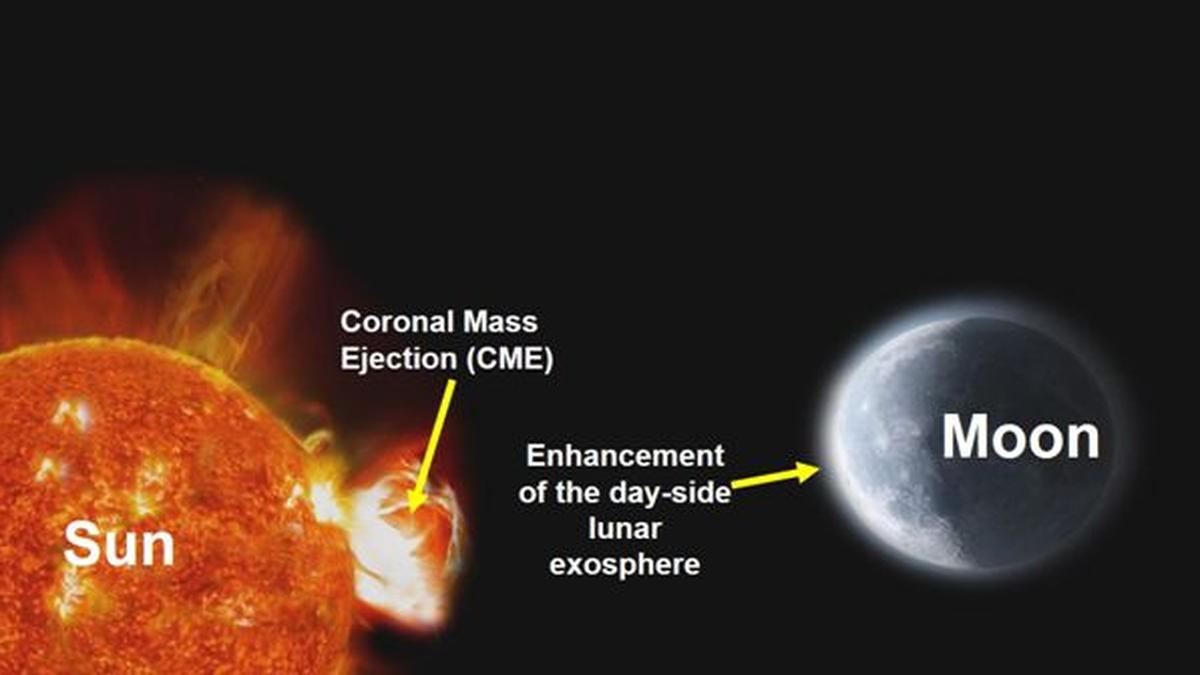
Through its suite of advanced instruments, the orbiter has successfully detected and analyzed interactions between solar particles and the lunar exosphere and surface. These observations have revealed how the continuous stream of charged particles from the Sun alters the composition and dynamics of the Moon’s thin atmosphere, as well as influences surface charging and dust movement.
Dr. S. Veeramuthu, a senior scientist at ISRO, stated, “Chandrayaan-2’s instruments have provided unprecedented data on the processes through which the Sun interacts directly with the Moon, enhancing our understanding of lunar surface processes and space weather phenomena.”
This discovery is significant as the Moon lacks a global magnetic field and a substantial atmosphere, making it directly exposed to solar wind effects unlike Earth. Understanding these interactions is essential for future lunar missions, particularly those involving human presence, as the solar wind influences surface radiation levels and dust dynamics that affect equipment and astronaut safety.
Moreover, the data gathered will aid scientists in interpreting the Moon’s geological history and its evolution over time. By studying the effects of solar particles on lunar soil and exosphere, researchers hope to gain insights into broader space weather impacts on airless celestial bodies.
ISRO’s Chandrayaan-2 mission thus continues to reaffirm India’s position in global space research, complementing other international lunar explorations. As global interest in Moon missions intensifies, such findings contribute valuable knowledge to the scientific community.
The mission team plans to release detailed scientific reports and papers outlining the full scope of the observations and their implications in the coming months. Meanwhile, ISRO has expressed its commitment to furthering lunar exploration with upcoming missions.
In summary, Chandrayaan-2’s groundbreaking observation marks a pivotal step in understanding the solar wind’s influence on the Moon, opening new avenues for research and exploration in lunar and planetary sciences.