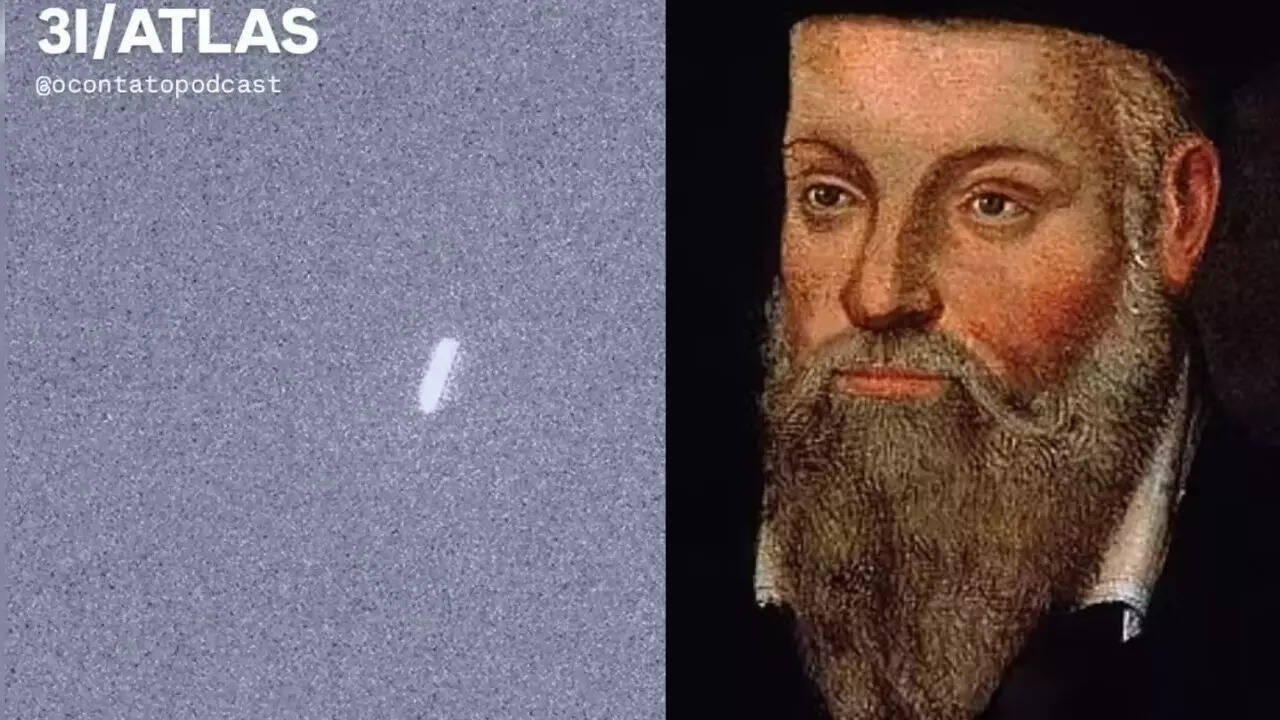
A rare interstellar object named 3I/ATLAS is predicted to approach Earth in 2025, attracting significant attention from the scientific community and prompting speculation about historical prophecies. Some observers have linked its arrival to predictions attributed to Nostradamus, sparking debates on the intersection of astronomy and prophecy.
Interstellar object 3I/ATLAS will approach Earth in 2025, attracting scientific study and sparking Nostradamus prophecy speculations worldwide.
A rare interstellar object designated 3I/ATLAS is anticipated to make a close approach to Earth in 2025, drawing widespread interest among astronomers and enthusiasts worldwide. The discovery, announced by scientists earlier this year, has not only intensified observational campaigns but also stirred speculation among some commentators linking the event to historical prophecies by the 16th-century seer Nostradamus.
3I/ATLAS is identified as the third confirmed interstellar object entering our solar system, following the earlier detections of ‘Oumuamua in 2017 and 2I/Borisov in 2019. Interstellar objects are celestial bodies originating outside our solar system, traveling at high velocities and providing valuable insights into the composition and dynamics of distant star systems.
The object was first detected by the Asteroid Terrestrial-impact Last Alert System (ATLAS) telescope network, which is designed to identify near-Earth objects that might pose impact risks. Its trajectory analysis shows that 3I/ATLAS will pass near Earth’s vicinity in late 2025, although there is no danger of collision.
Dr. Emily Carter, an astrophysicist at the University of Cambridge, noted that “the approach of 3I/ATLAS offers a rare opportunity to study material from another star system up close. Its composition and behavior could expand our understanding of planetary formation beyond our own solar neighborhood.”
While the scientific community focuses on data collection and analysis, the event has also caught the attention of those interested in historical prophecies. Discussions on social media and various forums have surfaced claims that Nostradamus’s quatrains hinted at the arrival of a celestial visitor in this period.
Nostradamus, a French astrologer and reputed prophet from the 16th century, penned cryptic verses widely interpreted as predictions of future events. However, experts caution that his writings are often vague and open to broad interpretation. Dr. Laura Mitchell, a historian specializing in Renaissance literature, emphasized, “Nostradamus’s quatrains are ambiguous and metaphorical; connecting them directly to specific modern events like 3I/ATLAS’s approach can be speculative without substantive evidence.”
Despite the skepticism, the juxtaposition of a rare astronomical event with centuries-old prophecy has fueled public interest and debate. The object’s passage could inspire further cultural and scientific discourse as more observations become available.
Space agencies and observatories worldwide plan to monitor 3I/ATLAS using a range of instruments, aiming to capture data on its velocity, trajectory, size, and composition. These observations will contribute to the broader study of interstellar objects’ nature and the dynamics of our solar system.
In summary, the anticipated arrival of interstellar object 3I/ATLAS near Earth in 2025 represents a significant moment for astronomical research while simultaneously inciting discussions about Nostradamus’s enigmatic prophecies. Scientists emphasize the importance of empirical study to understand these phenomena, while public curiosity highlights the enduring fascination with the intersection of science and mysticism.