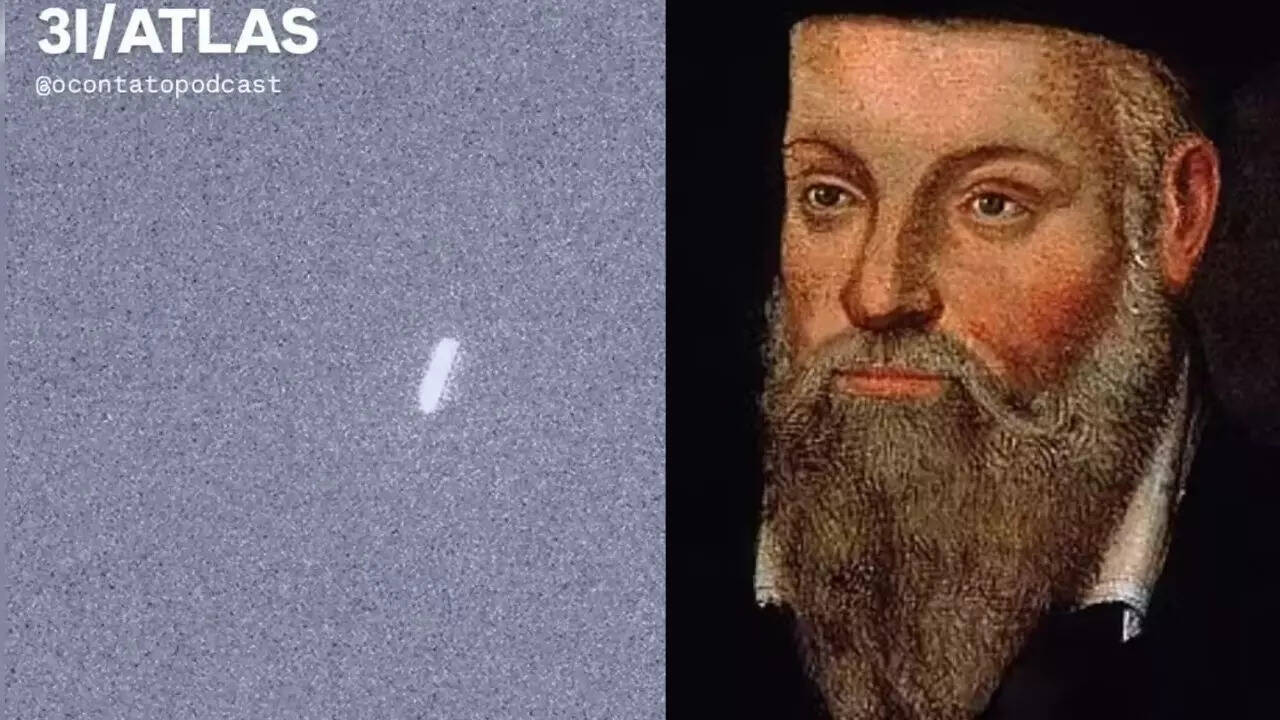
The rare interstellar object 3I/ATLAS is expected to pass close to Earth in 2025, igniting interest among astronomers and stirring speculation about predictions linked to Nostradamus. Researchers are closely monitoring the object’s trajectory, while enthusiasts explore possible prophetic connections.
Rare interstellar object 3I/ATLAS will approach Earth in 2025, drawing scientific interest and sparking discussions about Nostradamus prophecies.
Astronomers have identified a rare celestial visitor, the interstellar object 3I/ATLAS, which is projected to approach Earth in the year 2025. This discovery has garnered significant attention from the scientific community due to the object’s origin outside our solar system and its unusual trajectory. Simultaneously, the object’s impending arrival has stirred renewed interest among enthusiasts of historical prophecies, particularly those referencing the 16th-century seer Nostradamus.
3I/ATLAS was first detected in recent years by the Asteroid Terrestrial-impact Last Alert System (ATLAS), designed to identify potentially hazardous near-Earth objects. Unlike typical asteroids or comets, 3I/ATLAS is believed to have originated beyond the boundaries of our solar system, classifying it as an interstellar object. These objects offer scientists invaluable opportunities to study materials and phenomena from distant star systems.
The approach of 3I/ATLAS is expected around mid-2025, with precise orbital calculations indicating a relatively close pass by Earth, although no collision threat is anticipated. Dr. Elena Ramirez, an astronomer at the International Space Research Institute, stated, “Monitoring 3I/ATLAS allows us to learn more about the composition and dynamics of interstellar objects. Each such visitor enriches our understanding of the cosmos and the diversity of celestial bodies beyond our solar neighborhood.”
The fascination with 3I/ATLAS extends beyond scientific circles. Nostradamus, the 16th-century French astrologer and reputed prophet, is often associated with enigmatic predictions that some interpret as foretelling modern events. Certain interpretations of Nostradamus’s quatrains have been linked by enthusiasts to celestial occurrences, including the arrival of unusual cosmic bodies.
While there is no concrete evidence directly connecting Nostradamus’s writings to 3I/ATLAS, the timing and rarity of the object’s Earth approach have led to speculative discussions across various media platforms. Historian Dr. Marcus LeBlanc emphasizes caution, noting, “Nostradamus’s verses are notoriously opaque and metaphorical. Assigning them to specific events such as the approach of 3I/ATLAS is more reflective of contemporary imagination than historical fact.”
Scientifically, the focus remains on the observational campaigns planned for 3I/ATLAS. Numerous international observatories and space agencies are coordinating efforts to analyze the object’s composition, surface characteristics, and trajectory. Findings from these studies may provide unprecedented insight into materials formed around other stars, helping to refine models of planetary system formation and interstellar chemistry.
The intersection between scientific discovery and popular fascination highlights the enduring human curiosity about the cosmos and the mysteries it holds. As 3I/ATLAS approaches, the global community watches with anticipation, both for the valuable data it promises and the cultural conversations it sparks.
In summary, the anticipated 2025 approach of the interstellar object 3I/ATLAS marks a significant event in astronomy, offering a rare chance to study an extrasolar traveler near Earth. Although speculative links to Nostradamus’s prophecies have emerged, experts advocate for analysis grounded in empirical observation. The event reinforces ongoing efforts to monitor celestial phenomena that expand our understanding of the universe.