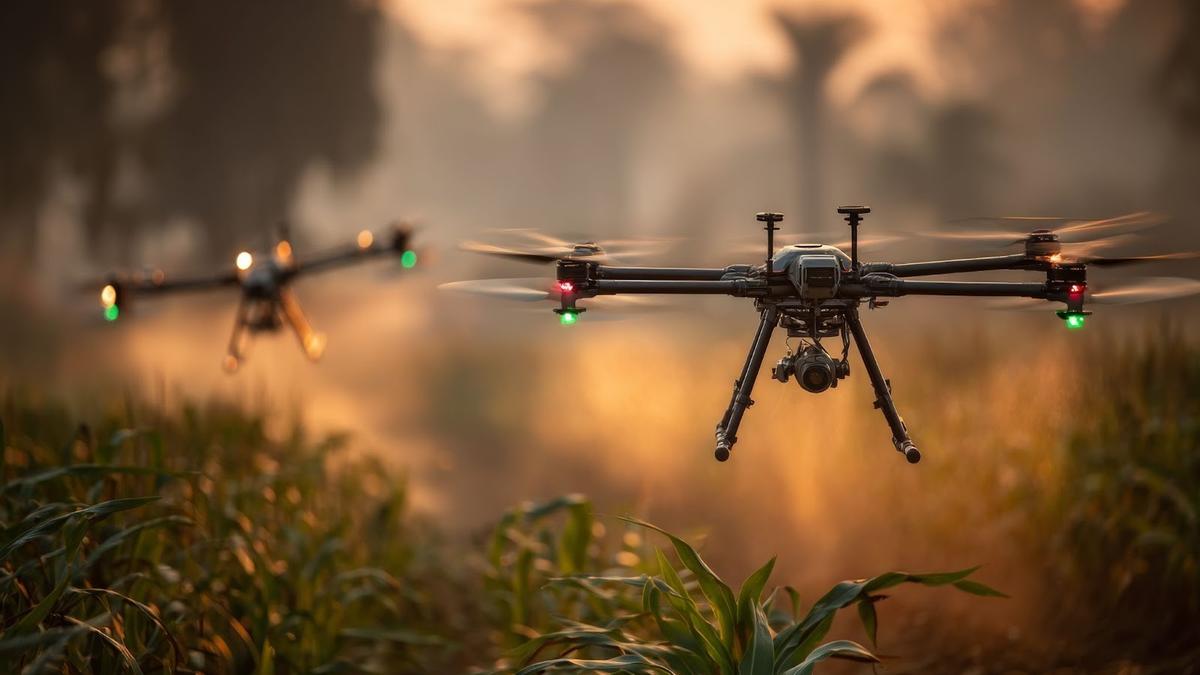
Researchers at IIT Bombay have developed a novel GPS-free control scheme for autonomous drone swarms, enabling coordinated flight without reliance on external satellite signals. This breakthrough promises enhanced reliability and efficiency in drone operations, particularly in environments where GPS signals are weak or unavailable.
IIT Bombay researchers develop a GPS-free control scheme enabling autonomous drone swarms to operate reliably without satellite navigation.
Mumbai, India – A team of researchers from the Indian Institute of Technology Bombay (IIT Bombay) has successfully developed a pioneering GPS-free control scheme that enables autonomous drone swarms to operate collaboratively without the need for satellite-based navigation systems. Announced on November 2, 2025, this innovation marks a significant advancement in the field of unmanned aerial vehicle (UAV) technology, potentially transforming applications ranging from disaster management to military reconnaissance.
The Challenge of GPS Dependency
Traditionally, drone operations have heavily depended on the Global Positioning System (GPS) to navigate and coordinate. However, GPS signals can often be unreliable due to signal obstructions, jamming, or spoofing, posing challenges in complex environments such as dense urban areas, indoors, or hostile terrains.
To address these limitations, IIT Bombay’s research team focused on creating a decentralized control system that allows swarms of drones to communicate and coordinate autonomously without GPS data. Their approach integrates advanced algorithms with onboard sensors to facilitate real-time decision-making and synchronization among drones.
How the GPS-Free Control Scheme Works
The innovative control scheme leverages local information sharing and consensus algorithms. Each drone in the swarm continuously exchanges positional and velocity data with its neighbors using wireless communication protocols. By processing this information using distributed control algorithms, the drones collectively maintain formation, navigate obstacles, and accomplish mission objectives without external navigation aids.
Dr. Arjun Mehta, lead researcher and professor at IIT Bombay’s Department of Electrical Engineering, explained, “Our system enables drones to operate in GPS-denied environments by relying solely on inter-drone communication and onboard sensing. This enhances the robustness and versatility of drone swarms in scenarios where GPS signals are compromised or unavailable.”
Applications and Potential Impact
This GPS-free control framework holds promise across various sectors. In disaster relief operations, where communication infrastructure is often damaged, drone swarms can autonomously coordinate search and rescue missions. Similarly, in military scenarios, this technology enhances stealth and reliability by eliminating the reliance on potentially vulnerable satellite signals.
Moreover, the scheme could facilitate indoor drone navigation in warehouses or manufacturing plants, boosting automation in logistics and inventory management. The reduction of GPS dependency also supports the development of drone applications in remote or obstructed environments.
The research team at IIT Bombay has conducted extensive simulations and prototype flights validating the effectiveness of their control scheme. The results demonstrate smooth formation maintenance, obstacle avoidance, and mission adaptability, showcasing the system’s potential for real-world deployment.
Global Significance and Future Directions
As drone technology continues to evolve globally, the ability to operate autonomously without GPS is becoming increasingly critical. The innovation by IIT Bombay contributes to this growing field, aligning with trends that emphasize resilience and security in UAV systems.
The researchers are now focusing on scaling up the technology for larger swarms and integrating machine learning techniques to further enhance the drones’ autonomous decision-making capabilities. Collaborations with industry partners are also underway to transition this technology from laboratory settings to commercial and defense applications.
In summary, the GPS-free autonomous control scheme developed by IIT Bombay researchers signifies a major step forward in drone swarm technology, promising more reliable, efficient, and versatile UAV operations across diverse scenarios worldwide.